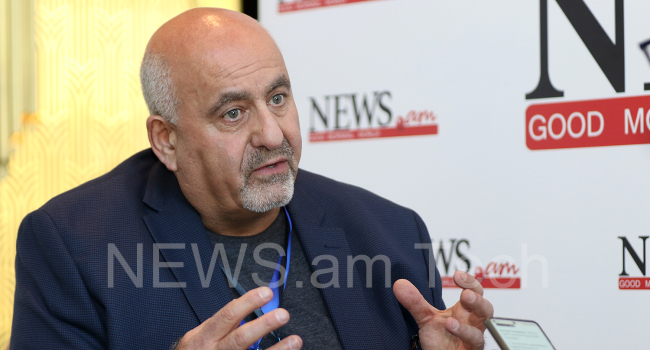
The Open Compute Project (OCP) has been at the forefront of transforming data center infrastructure and technology. Founded to drive innovation and sustainability in data centers, the organization is making a significant impact in the IT and cloud computing sectors. In an exclusive interview, held in the sidlines of the Silicon Mountains-2024 international technology summit held in Yerevan on November 15, George Tchaparian, the CEO of OCP, shared his thoughts on AI, sustainability, and the future of data center technologies.
AI: The driving force behind data center investments
When discussing the future of investments, Tchaparian emphasized the growing importance of AI in shaping data center technology. "Certainly, AI is emerging as a top use case driving data center deployments," he said, highlighting that AI is now a primary focus for the development of IT infrastructure. However, he noted that other use cases, such as Big Data Analysis and High-Performance Computing (HPC), also remain significant.
In response to how OCP is addressing the increasing demand for AI, Tchaparian pointed out that the community is investing in crucial areas such as cooling, interconnects, power distribution within IT racks, and high-speed memory. “The AI buildout cannot be achieved without many sustainability-related investments,” he added, stressing the importance of energy-efficient IT equipment and the reuse of heat in reducing the environmental impact of data centers.
Open Compute Project's influence on data center design
For over 12 years, OCP has been instrumental in reshaping the design and operation of data centers globally. Tchaparian highlighted the OCP Ready™ Program, which has played a pivotal role in ensuring that new data center facilities can support OCP-approved equipment. "Many of the newest data centers being designed are built to satisfy this checklist, having wide impact in the data center industry " he said.
The impact of OCP can also be measured financially. An independent study by IDC forecasts that in 2024, $41 billion will change hands between buyers of data center equipment based on OCP-approved specifications, with that number expected to rise to $74 billion by 2028.
“OCP allows for individuals and corporations of any size to have an impact on the future of the datacenter industry. By encouraging and even forcing collaboration, the OCP Community enables people to think differently, and more collaboratively,” he added.
Driving innovation in data center technologies
OCP has been responsible for numerous innovations in data center technologies. Tchaparian highlighted the development of an Open Chiplet Economy, which enables vendors to offer standalone chiplets integrated into a single System in Package. This advancement allows for more complex solutions tailored to specific domains such as AI, HPC, Aerospace, etc.
To accelerate the transition to liquid cooling, the OCP Community has been developing standards for liquid cooling connectors, building fluid distribution systems, and operating parameters for the fluids themselves.
Additionally, to ensure that technology flows from the very large-scale data centers to smaller enterprise on-premises data centers the OCP Community has redesigned data center servers to be highly modular, allowing for right sizing of server capacity and reuse of components across the supply chain, driving cost reduction and efficiencies.
Sustainability at the core of OCP's mission
Sustainability has long been a key priority for OCP, and Tchaparian reaffirmed that the organization’s mission includes making data centers more energy-efficient and environmentally friendly. The OCP community is working on various initiatives, including reducing the carbon footprint of data center facilities and IT equipment, as well as developing new metrics for measuring IT efficiency.
Tchaparian shared insights into OCP's efforts to tackle carbon emissions, mentioning a collaboration with iMasons to create a standardized methodology for carbon disclosure labeling. He also discussed OCP's work on making concrete more sustainable, a step toward reducing the carbon impact of data center construction. “By reducing cement, we can potentially reduce carbon emissions by 80%,” he noted, pointing to innovations such as SLAG and ASH as potential alternatives to traditional concrete.
The role of AI in future data centers
As AI continues to transform industries, it is clear that its integration into data center operations will be critical. Tchaparian discussed OCP’s proactive approach, citing the organization’s AI Strategic Initiative, which is focused on establishing open standards for AI clusters and the data centers that support them. " The OCP, with its Open Systems for AI Strategic Initiative, will impact the entire market with a multi-vendor open AI cluster supply chain," he said, emphasizing that this approach will reduce risks, lower costs, and accelerate market adoption.
The integration of AI into data center management could also lead to more automated operations. "We are considering how AI can be used to automate data center operations," Tchaparian explained. He also noted the potential of applying AI and digital twin technologies to optimize data center planning and reduce unused capacity.
Overcoming challenges in large-scale data centers
Despite these advancements, the challenges facing large-scale data centers remain considerable. Power, cooling, and sustainability are among the biggest concerns, particularly as AI workloads demand more energy and cooling resources. “We are trying to understand how we build a 250kW rack, how to keep it cool, and if this can be done in a sustainable way,” Tchaparian stated.
“These are large problems; much effort is going into solving these challenges and we will have to see how the technologies evolve over the next years to meet these challenges” he added.
OCP's global reach and future goals
Looking ahead, Tchaparian sees the OCP Project to foster collaboration across the data center industry. "The OCP’s Mission has been holding very steady for the last years, to maintain a hyperscale centric community the mover the data center industry forward for all by meeting today’s market requirements and shaping the future," he said. This involves a collaborative approach that brings together IT vendors, data center facility providers, telecom companies, and others to solve shared problems.
Regarding OCP’s future expansion, Tchaparian expressed optimism about extending its reach to new regions. "We are always looking to expand the reach of OCP to new countries and geographies," he noted, adding that they recently hired a full-time person for the Europe, the Middle East and Africa region.
Armenia, in particular, is an area of interest, as the country is home to several data centers. “By my visiting this week, and through the many people I have met, we have a good start at this, and we will have to see if we can keep the momentum going after my return to the US,” he said, hoping for more Armenian representation at future OCP summits.
“I hope that we will see lots of Armenian presence at our next OCP EMEA summit to be held in Dublin Ireland on April 29th and 30th. This will be two days where the latest innovations in data centre facilities and IT equipment will be on display, with in depth engineering presentations on what is next” he added.

 make preferable