make preferable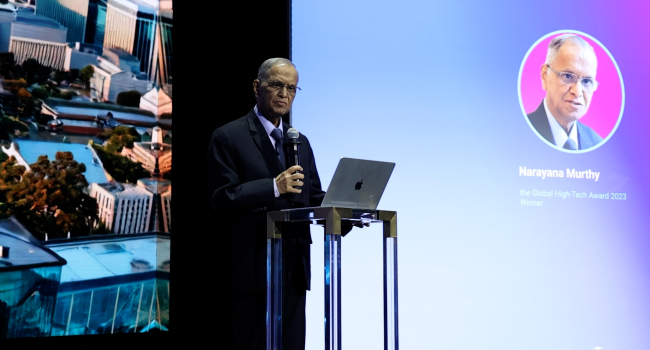
India is the third largest economy in the world, with a per capita GDP of $2,300 in 2023. In our country, a decision was made in the 2000s to strengthen digitalization in the country so that people could feel the changes as a result of the reforms. This was stated by Narayana Murthy, the founder of Infosys, laureate of the 2023 State Award of the Republic of Armenia for Global Investment in High Technologies, at the international technology summit Silicon Mountains–2024 held in Yerevan on November 15.
He said that measures were then taken to digitalize the economy to ensure maximum access to cashless services.
"The entire digital strategy was aimed at developing a knowledge-intensive economy, and to increase the availability of services, it was necessary to introduce high-speed Internet. After that, digital services were introduced, including in the tax sphere and in public administration. This increased efficiency, reduced costs and bureaucracy, allowing the maximum number of people to start using banking, insurance and other types of services,” he said.
As part of the increase in non-cash payments, various types of payments were introduced: mobile wallets, online banking, mobile banking and other tools, Murthy added.
“India was one of the weakest countries in the world in terms of banking until 2008, but now 96% of citizens have bank accounts. If not for the digital changes that have taken place over the years, this process would have taken 50 years.
"Additionally, tax collections have quadrupled between 2010 and 2022. The reforms have resulted in India creating one of the most efficient digital ways to distribute vaccines. The country has also become the third largest online shopping country in the world (after the US and China), with 140 billion transactions three years ago," Murthy said.
The Financial Times named him one of the top ten technology business pioneers in 2005.