make preferable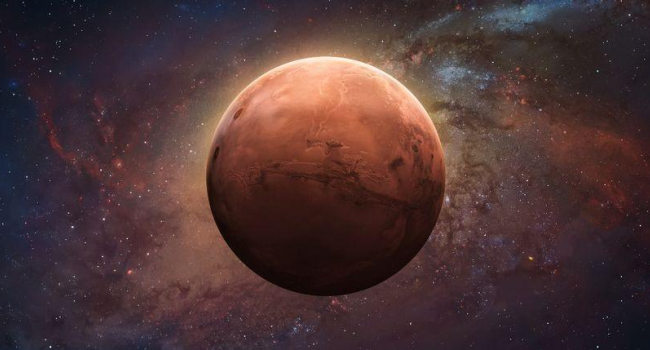
Scientists at Harvard's Paleomagnetic Laboratory have published a new paper in the scientific journal Nature Communications in which they argue that Mars may have had a magnetic field that could have sustained life-friendly conditions until about 3.9 billion years ago. This discovery contradicts previous estimates, according to which the magnetic field of Mars disappeared hundreds of millions of years ago.
The study, led by Graduate School of Arts and Sciences student Sarah Steele, used computer modeling to estimate the age of Mars' global magnetic field. The team focused their efforts on a theory they first proposed last year: the theory is that Mars' magnetic field has existed longer than most estimates suggest.
They developed this idea after experiments simulating the cooling and magnetization cycles of large craters on the Martian surface. These craters are known to have a weak magnetic field, and researchers hypothesized that they formed after the planet's global magnetic field weakened. However, the Harvard team argues that this is not a necessary condition to explain the existence of these largely demagnetized craters.

Steele says their results build on previous work that, for the first time, has changed the current timeline for life-friendly conditions on Mars. They used the Martian meteorite Allan Hills 84001 and a powerful quantum diamond microscope to help infer a magnetic field that existed for a longer period of time, up to 3.9 billion years ago.
“We're trying to answer basic, important questions about how things got to be the way they are, and even why the entire solar system is the way it is. "Planetary magnetic fields are our best probe for answering many of these questions, and one of the few ways we can learn about the depths and early history of planets," Steele said.