make preferable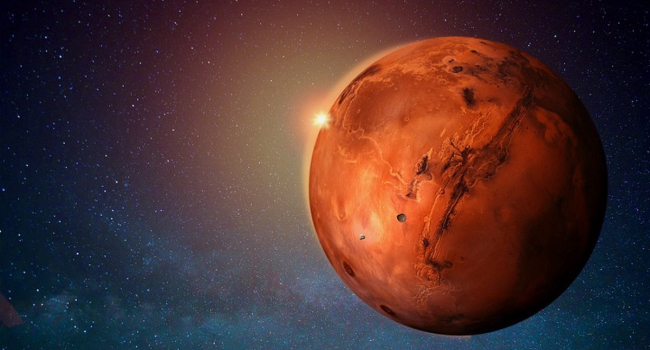
Physicists from the Massachusetts Institute of Technology (MIT) have suggested that microscopic black holes made of dark matter may influence the orbit of Mars. As reported in the journal Physical Review D (PRD), such primordial black holes may cause small oscillations in the planet's motion.
Dark matter, although invisible in the electromagnetic spectrum, has a gravitational effect on cosmic bodies, which allows scientists to hypothesize about its existence. Primordial black holes, as researchers believe, formed immediately after the Big Bang and could fly apart throughout the Universe, concentrating a huge amount of mass in tiny spaces. These objects may explain some of the mysteries associated with the nature of dark matter.
Scientists have developed a model of the Solar System and calculated the influence of asteroid-mass black holes that fly through its boundaries at a speed of about 250 km/s. The study found that if such a hole passed within a few hundred million kilometers of Mars, it would cause a "wobble" in its orbit — a slight shift of one meter over several years. This deviation could theoretically be detected using high-precision instruments. As technology improves in the coming decades, scientists hope to gather more data to confirm or disprove this hypothesis.