make preferable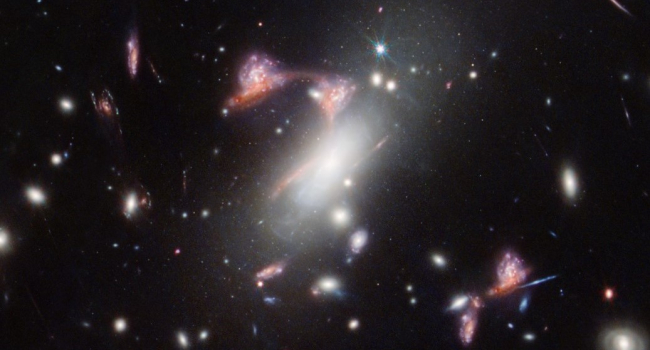
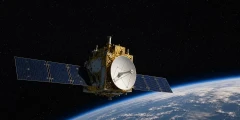
The James Webb Space Telescope (JWST) has discovered a rare gravitational lens configuration that allows astronomers to peer into the past of the universe and study galaxies that formed 7 billion years ago. This finding, published in the Monthly Notices of the Royal Astronomical Society, provides valuable insights into star formation in the early universe and offers clues about what the Milky Way might have looked like at that time.
The gravitational lens identified by the telescope takes the unusual shape of a question mark, formed by two interacting galaxies. One of the galaxies, red and dusty, was only detected with the help of JWST, as its longer infrared wavelengths can penetrate cosmic dust, while shorter wavelengths seen by the Hubble telescope get trapped in the dust.
Astronomers used both telescopes to observe the galaxy cluster MACS-J0417.5–1154, which acts as a magnifying glass, allowing them to see enhanced details in more distant galaxies. However, gravitational lensing also causes distortions, making galaxies appear stretched and show up multiple times in the image.
The red galaxy discovered by JWST and the spiral galaxy previously detected by Hubble are magnified and distorted in a rare alignment between the distant galaxies, the lens, and the observer. This explains the five images of the galaxy pair seen in the JWST image, four of which outline the upper part of the question mark.
The research team that discovered this configuration also explored the Webb NIRISS instrument’s capabilities for detecting star-forming regions in a galaxy billions of light years away. The results show widespread star formation in both galaxies, with the newly discovered dusty galaxy located at the same distance as the spiral galaxy facing the observer.
“Understanding where, when, and how star formation occurs in galaxies is crucial for understanding how galaxies evolved throughout the universe's history. Both galaxies in this pair show active star formation in several compact regions, likely the result of gas collisions between the two galaxies,” said astronomer Vicente Estrada-Carpenter.
This discovery offers valuable insight into star formation in the early universe and suggests how the Milky Way may have appeared at that time. “These galaxies, which we observed billions of years ago at the peak of star formation, have masses similar to what the Milky Way’s mass would have been at that time. James Webb allows us to study what the early stages of our galaxy were like,” said astronomer Marcin Sawicki.