make preferable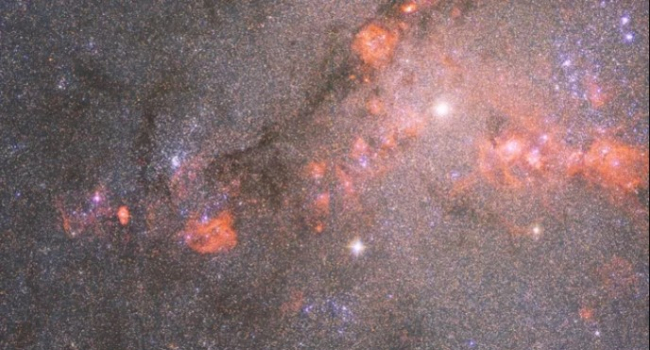
The Hubble Space Telescope has transmitted a unique image of the spiral galaxy Messier 33 (M33), also known as the Triangulum Galaxy, back to Earth. The image clearly shows the star formation process occurring in this galaxy at an astonishing rate.
The Triangulum Galaxy is the third-largest member of the Local Group of galaxies, following the Andromeda Galaxy (M31) and our Milky Way. Its diameter is only 60,000 light-years, which is about half the size of the Milky Way. The distance from Earth to M33 is nearly 3 million light-years.
According to NASA researchers, the Triangulum Galaxy is a "hotbed of star formation," where stars form at a rate 10 times higher than in the neighboring Andromeda Galaxy. The neat, organized spiral arms of M33 indicate minimal interaction with other galaxies, so its rapid star formation is not caused by galactic collisions, as is common in many other galaxies. Instead, new stars are born from the large amounts of dust and gas within the galaxy.
Collisions between massive ionized hydrogen clouds, known as H-II regions, create massive stars that can be seen in the new Hubble image. The large reddish clouds in the photograph represent pockets of ionized hydrogen, which, along with dark streams of gas, fuel the rapid star formation in the galaxy.
"The apparent graininess of the image is actually swarms of countless stars. M33 is one of fewer than 100 galaxies close enough for telescopes to distinguish individual stars, as seen in the new image," NASA representatives stated.
However, unlike most spiral galaxies, M33 lacks a central bulge that would otherwise house a supermassive black hole. As a result, M33 is classified as a "pure disk galaxy," a type of galaxy believed to make up about 15-18% of all galaxies in the universe.
The new Hubble image, published on August 21, was taken as part of a larger study of the interstellar medium, star formation processes, and stellar evolution, which scientists hope will provide insights into the possible future merger of M33 with Andromeda.