make preferable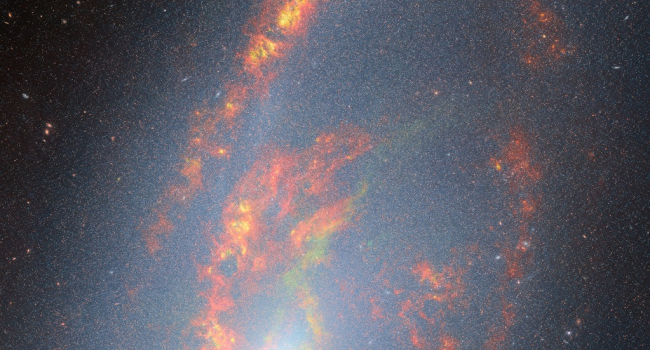
Scientists at the European Space Agency (ESA) have released stunning images of the spiral galaxy Messier 106, captured by the James Webb Space Telescope. These images allow us to peer into previously hidden regions of the galaxy and uncover new secrets of the universe.
Messier 106, also known as NGC 4258, is a nearby spiral galaxy located in the constellation Canes Venatici. Thanks to the near-infrared camera on board the space telescope, scientists were able to penetrate through dense clouds of stellar dust and discover new details about the galaxy.
At the center of the galaxy lies a supermassive black hole that is actively consuming material. This distinguishes it from the black hole at the center of the Milky Way, which only occasionally pulls in gas. As the gas spirals toward the black hole, it heats up and emits powerful radiation, visible in the images as a bright area.
The galaxy's arms are seen as wide bands of glowing gas and dust in the images. The blue areas represent star dust scattered throughout the galaxy, while the orange indicates warmer dust, and deeper red tones represent cooler dust. The turquoise, green, and yellow hues near the center of the image reflect different gas distributions.
But that's not all—Messier 106 also has two "invisible" arms that are only visible in radio and X-ray wavelengths. These arms consist of hot gas and are believed to be the result of black hole activity. "They are likely caused by material outflows created by the turbulent mixing of gas around the black hole, which creates a phenomenon similar to a wave breaking against a rock on the shore," explain the scientists.
Such observations will help astronomers better understand important galactic processes like star formation and black hole physics, ultimately revealing the nature and history of the universe.
The James Webb Space Telescope continues to amaze with its capabilities and uncover new secrets of the universe. Its near-infrared camera allows it to see farther and deeper than any other telescope, giving scientists a unique opportunity to study previously hidden regions of galaxies.