make preferable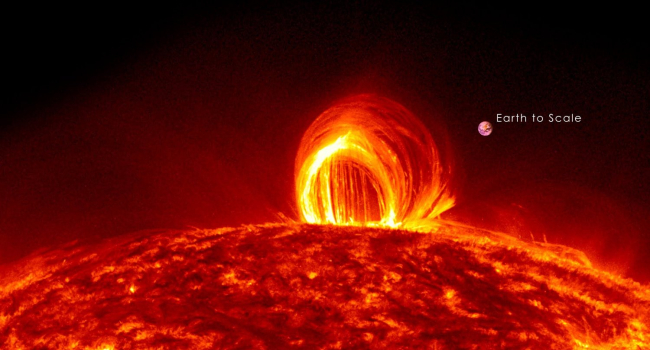
On August 14, a powerful solar flare of class X occurred on the Sun, peaking at 06:40 UTC (2:40 AM Eastern Time). This flare caused shortwave radio disruptions over Asia and the Indian Ocean and could potentially lead to geomagnetic storms and increased aurora activity.
What makes this solar flare particularly interesting is that it originated from the unusual sunspot AR3784, which has already drawn the attention of scientists and aurora enthusiasts due to its strange polarity. The spot's polarity violates the century-old Hale’s Law, which states that sunspots in the Northern Hemisphere should be polarized as -+. Instead, sunspot AR3784 is polarized as ±, showing a rotation of 90 degrees, according to Spaceweather.com.
This is not the first sunspot to break the rule, as this phenomenon occurs in about 3% of cases. However, most “rule breakers” exhibit “reverse polarity” (+- instead of -+), while AR3784 sits somewhere between these two states.

Experts at Spaceweather.com suggested that “the magnetic foundations of this spot are twisted in an unusual way. If the opposing magnetic polarities twist too much, it could result in an X-class solar flare.” And indeed, that’s exactly what happened with this sunspot.
Solar flares are explosions on the surface of the Sun that release intense bursts of electromagnetic radiation. These flares occur when accumulated magnetic energy in the solar atmosphere is released. They are categorized by size into different classes, with X-class flares being the most powerful. M-class flares are 10 times less intense than X-class, followed by C-class flares, which are 10 times weaker than M-class. B-class flares are 10 times weaker than C-class, and A-class flares, which are 10 times weaker than B-class, have no significant impact on Earth. Within each class, numbers from 1 to 10 (and beyond for X-class) indicate the relative strength of the flare.
Powerful solar flares like the one that occurred this morning are often accompanied by a coronal mass ejection (CME) — a large plume of plasma and magnetic field from the Sun. It has not yet been confirmed whether this eruption was accompanied by a coronal mass ejection.
Coronal ejections carry electrically charged particles, ions, that collide with Earth's magnetosphere and can cause geomagnetic storms. During these storms, ions interact with gases in Earth's atmosphere, releasing energy in the form of light. This phenomenon is known as the northern lights or aurora borealis in the Northern Hemisphere and the southern lights or aurora australis in the Southern Hemisphere.
If the CME is confirmed, we could see more geomagnetic storms and increased auroral activity.