make preferable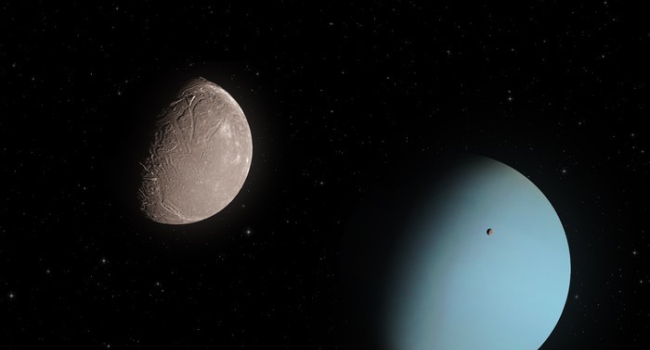
Scientists from the Johns Hopkins Applied Physics Laboratory (APL), led by planetary scientist Richard J. Cartwright, used the NIRSpec infrared spectrometer on the James Webb Space Telescope to chemically analyze the surface material of Ariel, one of Uranus's closest moons. Ariel is the brightest of Uranus's moons, with a significant portion of its surface covered in ice. Scientists have long been interested in the nature and formation of this ice, Space.com reports.
The only partial image of Ariel was captured by NASA's Voyager 2 probe on January 24, 1986. A mission to the Uranus (and Neptune) system would be a significant boon for scientists, but it is not currently planned. There are speculations that the Chinese might be planning something, but there are no concrete details.
The ice on Ariel's surface is unevenly distributed. Since the moon is tidally locked to Uranus (always showing the same face to the planet), the ice layer is thicker on the far side, up to 10 mm, while on the near side, it is only 0.3 mm. Analysis showed that the ice is primarily frozen carbon dioxide. The data from Webb also revealed traces of carbon monoxide and several other chemical compounds, including carbonates, on Ariel.
Seasonal changes on Ariel should have caused significant amounts of carbon dioxide to escape from its surface, but this does not seem to be happening. Some source or sources are replenishing its levels. Carbon dioxide may be replenished through chemical reactions in the presence of charged particles from Uranus's magnetosphere (a process known as radiolysis). However, a subsurface global ocean could also be replenishing it.
The far side of Ariel is riddled with small and large cracks. Substances can seep through these cracks or be dispersed as aerosols around the moon through cryovolcanic activity. Such processes could explain the abundance of carbon dioxide ice on Ariel. The presence of carbonates also supports the idea of a subsurface ocean, as these salts form when water interacts with rocks.
Finally, the detected deposits of carbon monoxide on Ariel cannot be explained by any means other than its constant replenishment from the moon's interior. For this gas to cool and condense into solid deposits on Ariel's surface, the temperatures would need to be at least 18°C colder. These indirect hints suggest the presence of a subsurface ocean on Ariel. Collectively, these findings may provide scientists with crucial insights for the search for oceans on exoplanets. In our solar system, water is also valuable, especially so far from Earth (and the Sun).