make preferable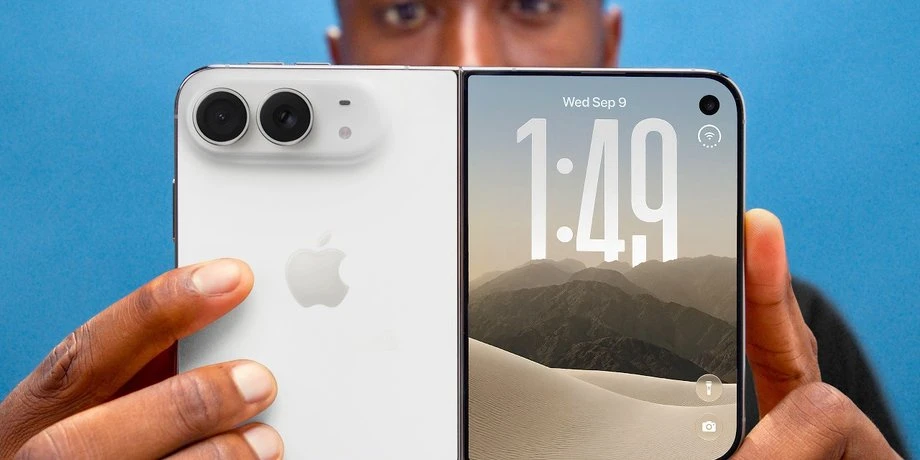
The first foldable iPhone turned out to be more interesting than it may have seemed from the presentation. In addition to two screens, a new hinge, and the usual set of cameras, the iPhone Duo received several solutions unusual for Apple: an under-display front camera, Touch ID instead of Face ID, eSIM only, and even IP68 protection. Some other features, on the contrary, had to be removed for the sake of the foldable design.
Here are the details you could have easily missed during the announcement.
Under-display camera — a first for iPhone
The internal screen of the iPhone Duo became the first iPhone display without a notch or Dynamic Island. The front camera is hidden directly under the screen, so the display takes up its entire surface.
At the same time, there are actually two front cameras, and their capabilities differ. The under-display camera of the internal display is noticeably simpler than the external Center Stage camera. So for high-quality selfies and video calls, it makes more sense to use the external camera, while leaving the under-display one for situations where convenience matters more.
The main camera of the Duo is a 48-megapixel Dual Fusion unit. Externally, its module resembles the main camera of the iPhone 17, although the exact sensor version can only be determined after a teardown of the device. The variable aperture introduced in the iPhone 18 Pro is not present here.
However, Apple did add several software features designed specifically for the foldable format, including Smart Take, Kid Cue, and Duo Preview.
At the same time, it does not reach the professional capabilities of the Pro Duo models. The smartphone cannot shoot spatial photos for Vision Pro, and it also does not support ProRAW, ProRes RAW, Apple Log 2, Genlock, or Apple Reference Image.
Face ID is gone, and the volume buttons became “smart”
Another unexpected decision is the removal of Face ID. Instead, Apple brought back Touch ID: the fingerprint scanner is built into the power button, as in some iPad models.
Why the company abandoned Face ID specifically in the foldable iPhone was not explained. At the same time, placing the scanner in the button is convenient because it remains accessible in both the folded and unfolded states.
The familiar Action button is gone as well. In its place on the side edge is the Camera Control, which provides quick access to shooting.
Meanwhile, the volume buttons gained a feature familiar from the iPad. They automatically account for the orientation of the device. So when the opened Duo is rotated, the buttons determine where the top and bottom are and continue to work intuitively.
The internal screen comes only with a nano-texture coating
The internal display of the iPhone Duo has another feature: Apple offers it exclusively with a nano-texture coating. You cannot choose a regular glossy version.
The external screen, by contrast, remains glossy. This is also where the external front camera is located.
Another characteristic unusual for a foldable smartphone is IP68 dust and water resistance. For devices with a complex hinge mechanism, this level of protection is not very common.
MagSafe is here, but Apple’s wallet won’t fit
The Duo does have MagSafe magnets in its body, but Apple’s proprietary MagSafe Wallet cannot be fully used with this smartphone because it blocks the camera module.
Charging, however, is in better shape. The iPhone Duo can charge to 50% in about 20 minutes when using Apple’s 40-watt adapter with dynamic power up to 60W.
Another interesting capability is related to USB-C. The port supports USB 3 and DisplayPort, so the Duo can output an image directly to an external display. The thinner iPhone Air does not have this capability.
eSIM only — even in China
Apple completely abandoned the physical SIM card in the iPhone Duo. The smartphone supports only eSIM, and this applies to all markets, including China.
To launch this version in China, Apple had to separately coordinate the device with local regulators. This was one of the reasons why the sales launch happened later than usual.
The Duo also supports satellite connectivity for messages and emergency calls. Apple extended free access to this feature for iPhone users for another year.
When unfolded, the Duo is thinner than the iPhone Air
When unfolded, the iPhone Duo is 5.2 mm thick. This is more than some rumors had suggested, according to which the body was supposed to be 4.5 mm thick, but it is still less than the thinnest regular iPhone — the iPhone Air at 5.64 mm.
When folded, the thickness increases to 11.3 mm.
The smartphone weighs 254 grams. That is almost the same as the iPhone 18 Pro Max — 250 grams. For a foldable device with two displays, such a weight looks especially notable: by weight, the Duo is roughly on the level of a large conventional flagship.
Duo will arrive later than the other iPhones
The iPhone Duo will ship with iOS 27.1. This version of the system is expected to be released on October 22, and some features of the smartphone itself will become available only after separate updates.
There are also limitations regarding the stylus. At launch, the regular Apple Pencil with USB-C will be supported, while Apple Pencil Pro is not yet supported.
Preorders for the iPhone Duo will open on October 16, and the first buyers will receive their smartphones on October 23 — significantly later than the release of the iPhone 18 Pro.
There are several reasons for the delay. The foldable body is more difficult to manufacture, so Apple needs additional time to build inventory. In addition, app developers had to adapt their software to the unusual dual-screen format. Finally, another factor was the approval of the eSIM version of the device for the Chinese market.
As a result, the iPhone Duo differs from regular iPhones not only in its ability to fold. Apple simultaneously added several solutions new to the company — from an under-display camera to IP68 — and abandoned familiar elements such as Face ID, the Action button, and the physical SIM card.
These less noticeable details will largely determine the everyday experience of owners. For the first foldable iPhone, not only the very appearance of a second screen matters, but also how Apple reworked the familiar smartphone elements around the new form factor.