make preferable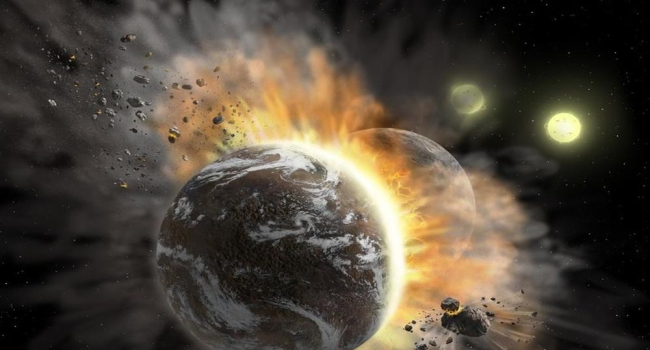
Scientists from the University of California, Berkeley, have revealed how giant collisions between young planets can generate seismic waves that persist for millions of years. These vibrations, which alter a planet’s brightness in the infrared spectrum, could potentially be detected by the James Webb Space Telescope. The study, published as a preprint on arXiv, focuses on the exoplanet Beta Pictoris b—a young “super-Jupiter” whose history may hold evidence of cosmic catastrophes. We explain how this works and why the discovery is significant for astronomy.
Beta Pictoris b: A Battlefield of a Young System
The formation of planetary systems is a chaotic process, resembling a battlefield where collisions between planetary embryos leave marks, much like craters on the Moon. The exoplanet Beta Pictoris b, located 63 light-years from Earth, is an ideal subject for studying such processes:
- Characteristics: A mass 13 times that of Jupiter (~13 M_J), an age of 12–20 million years, and an orbit ~10 AU from the star Beta Pictoris.
- Composition: Contains 100–300 Earth masses of heavy elements (silicates, metals), likely accumulated through mergers with other planets.
- Youth: The system is still forming, surrounded by a dusty disk, making it a “laboratory” for studying planetogenesis.
Scientists modeled a hypothetical collision between Beta Pictoris b and a Neptune-mass planet (~17 Earth masses) to understand how such events affect the planet.
Seismic Waves from Cosmic Impacts
Massive collisions generate seismic vibrations that can persist for millions of years due to low damping in gas giants. Researchers identified two types of waves:
- Surface f-modes: Similar to ripples on water, these oscillate the planet’s outer layers.
- Acoustic p-modes: These penetrate deeper, causing compression and expansion of the gas.
These waves alter the density and temperature of the atmosphere, leading to variations in infrared brightness (wavelengths 1–5 μm). Such changes can be detected by the Webb Telescope due to its sensitivity to infrared radiation (using NIRCam and MIRI instruments).
Key Model Findings:
- A collision with a 17 Earth-mass planet could excite vibrations lasting 9–18 million years.
- Brightness amplitude varies by 0.1–1%, within Webb’s detection capabilities.
- If the collision occurred within the last 18 million years, traces could be observable now.
“Seismology provides a direct path to studying the interiors of giant planets,” the authors emphasized. This is the first instance where exoplanet seismic waves have been linked to telescope observations.
Why It Matters
The discovery is significant for astronomy and planetary science:
- Internal Structure: Seismic waves reveal the composition and density of exoplanet interiors, similar to how terrestrial seismology studies Earth’s core.
- Formation History: Collision traces confirm that Beta Pictoris b grew through mergers, much like the Moon bears scars from meteorites.
- Webb’s Observations: The telescope can not only image exoplanets but also “listen” to their vibrations, making it a unique tool.
What’s Next?
Scientists plan to:
- Observe Beta Pictoris b with Webb (2025–2026), searching for brightness variations in the infrared spectrum.
- Model collisions for other exoplanets, such as HR 8799 c–e (age ~30 million years).
- Develop algorithms for analyzing seismic signals, possibly using AI (like SIFT for blazars).
If Webb confirms these vibrations, it will mark the first observation of seismic activity beyond the Solar System.
Conclusion
Berkeley scientists have shown that collisions involving young planets like Beta Pictoris b can generate seismic waves that persist for millions of years. These vibrations, which alter a planet’s brightness, can be detected by the James Webb Space Telescope, offering a window into the internal structure of exoplanets. The discovery transforms the cosmos into a seismic laboratory, where traces of ancient catastrophes reveal the story of world formation.