make preferable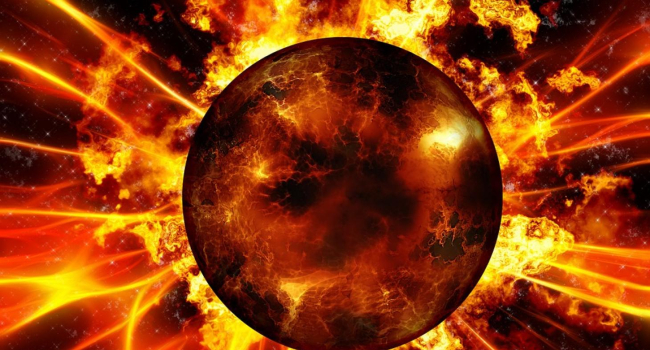
Scientists from the Massachusetts Institute of Technology (MIT) have discovered a remarkable exoplanet that is literally evaporating under the scorching heat of its star. Named BD+05 4868 Ab, this planet in the constellation Pegasus trails a 9-million-kilometer dust tail, losing mass with every orbit. Published in Astrophysical Journal Letters, the study unveils details of this cosmic phenomenon and its significance for science. Here’s how they found this burning world, why it’s disintegrating, and what it means for the search for life.
An Evaporating World: What’s Happening to BD+05 4868 Ab?
Located 140 light-years from Earth, BD+05 4868 Ab is a rocky planet, sized between Mercury and the Moon. It orbits an orange dwarf—a star slightly cooler than the Sun—at an extremely close distance, 20 times nearer than Mercury is to our Sun. A full orbit takes just 30.5 hours, making it one of the fastest-orbiting exoplanets known.
Due to its proximity, the planet’s surface is heated to 1600°C—a temperature that turns rocks into magma. With each orbit, BD+05 4868 Ab loses about 350 billion tons of mass, equivalent to Mount Everest. The evaporating minerals form a massive 9-million-kilometer dust tail, resembling a comet’s. This rare phenomenon makes the planet visible to telescopes.
“We’re watching a planet burn in real time. It’s a unique chance to peer into its core,” said one of the study’s authors.
How Was the Burning Planet Found?
The discovery was made using NASA’s TESS (Transiting Exoplanet Survey Satellite), which tracks changes in star brightness. Scientists noticed periodic dips in the orange dwarf’s light every 30.5 hours, caused by the planet’s transit across the star. However, an anomaly stood out: the star’s brightness dimmed unevenly, suggesting a dust tail trailing the planet.
Further observations confirmed:
- Transits: The planet and its tail partially block the star’s light, creating a complex pattern of dimming.
- Spectroscopy: Light analysis revealed mineral dust rich in silicon and magnesium in the tail.
- Modeling: Calculations showed the planet loses mass due to its crust evaporating under stellar radiation.
Researchers suggest BD+05 4868 Ab wasn’t always so close to its star. It likely formed on a farther orbit but was “pushed” inward by the gravitational influence of another planet or star in the system. This mirrors the fate of “hot Jupiters” like HD 189733b, but BD+05 4868 Ab is a rare case of a rocky planet with visible destruction.
Why Does This Matter?
The discovery offers a unique opportunity to study exoplanets and their evolution:
- Geology Without Probes: The dust tail contains minerals from the planet’s crust, mantle, and possibly core. Analyzing its composition with the James Webb Space Telescope (JWST) will “dissect” its structure, like an autopsy, without sending missions.
- Planetary Evolution: Observing evaporation reveals how terrestrial planets break down in extreme conditions, shedding light on how Mercury or Earth might behave as the Sun brightens in the future.
- Search for Life: While BD+05 4868 Ab is uninhabitable, its study refines models of planetary system formation. This ties to discoveries like Krebs cycle molecules in space, hinting at life’s cosmic origins.
For comparison, the planet WASP-12b, discovered in 2008, also evaporates but is a gas giant losing its atmosphere. BD+05 4868 Ab is the first rocky planet with such a vivid tail, making it a “living laboratory” for astronomers.
Connections to Other Discoveries
The finding resonates with other 2025 astronomical breakthroughs:
- University of Arizona’s Coronagraph: This tool for directly imaging exoplanets could aid studies of worlds like BD+05 4868 Ab, despite their proximity to stars.
- Andromeda Anomaly: Galactic mergers, like those in M31, may have created conditions for such extreme planetary systems.
- Earth’s Climate: Solar heating studies suggest that in a billion years, Earth could resemble BD+05 4868 Ab if humanity doesn’t find a new home.
X users call the planet a “cosmic firework”: “It’s burning, leaving a dusty trail like a comet! This is the universe’s spectacle.” Others jest: “xAI’s Grok is probably ready to analyze its tail through an iPhone 18 camera!”
What’s Next?
Scientists plan to use the James Webb Space Telescope to analyze the tail’s chemical makeup. Infrared spectroscopy will reveal which minerals—silicates, oxides, or metals—are evaporating, offering clues about the planet’s interior. They’ll also check for other planets in the system that may have altered BD+05 4868 Ab’s orbit.
Future missions, like the Nancy Grace Roman Telescope (launching 2027), will enhance the search for similar worlds. In tech hubs like Xiong’an, where AI speeds up telescope data processing, such discoveries may become more frequent. If the tail contains rare elements, it could also shed light on rocky planet formation in the early universe.