





 make preferable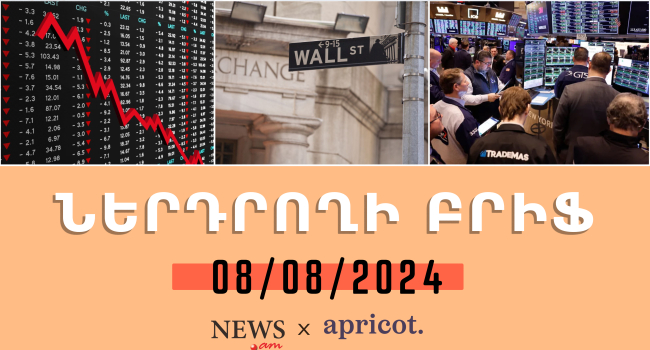
NEWS.am together with Apricot Capital is launching a new project "Investor's Brief" in order to contribute to the formation of investment culture in Armenia. From now on, every Thursday on our website and YouTube channel, you can get the latest news of the global financial markets in order to be aware of the transition of the sector and get to know the investment world better.
Against the backdrop of concerns about the decline of the US economy, a sharp decline was recorded in the world financial markets this week. On Monday, June 5, the biggest drop in the last two years took place in the US stock market. On the same day, the S&P 500 fell 3%, the Dow Jones industrial average fell more than 1,000 points and the Nasdaq Composite fell 3.4%.
The massive sell-off in stocks around the world began with Japan's Nikkei 225 falling 12.4%, the biggest since Black Monday in 1987. South Korea's Kospi index fell by 8.8%, and stock markets across Europe fell by more than 2%.
Nevertheless, the very next morning, the Japanese stock market began to rise again, recouping most of the previous day's losses, and stability was established on Wall Street.
On Tuesday, August 6, London's FTSE 100, which had fallen 2% yesterday, rose 18 points or 0.2%. On Wall Street, Dow Jones closed up 0.8%, S&P 500 - up 1.5%. Nasdaq registered a 1% increase. The Japanese Nikkei 225 closed up 10.2% compared to the previous day. Other Asian stock markets also rose.
The jitters in global stock markets came after a US jobs report showed the US unemployment rate hit a three-year high of 4.3% in July, down from 4.1% the previous month, amid a sharp slowdown in hiring. This has fueled fears that the labor market is deteriorating, signaling an impending economic downturn. Just a few days before this report, the stock indices in the US reached their best figures in recent months, after the chairman of the Federal Reserve System, Jerome Powell, expressed hope that a reduction in the refinancing rate is possible from September.
But after the unemployment report, fears grew that the Federal Reserve may have been too late to cut the refinancing rate, raising the risk of a crisis in the world's largest economy.
Traders are now wondering if the damage has been so severe that the Federal Reserve will be forced to cut refinancing rates in an emergency meeting instead of waiting for a regular meeting scheduled for September 18.
Against the backdrop of expectations of a decline in the US economy, the yield curve of US treasury bonds has turned positive for the first time in the last two years. This means that short-term bonds had a lower yield than long-term bonds. This situation usually suggests that the country's economy is on the verge of recession.
Are you interested in investing? Discover their opportunities with Apricot Capital.
Apricot Capital is controlled by the Central Bank of RA.