




 make preferable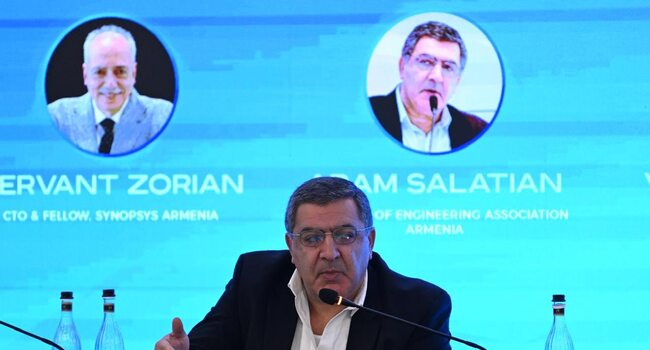
Armenia is perceived today as a country with a strong engineering school and notable technological achievements on the global market. However, according to Aram Salatian, President of the Engineering Association of Armenia, the country is currently facing a key strategic choice: will it remain a development center or manage to transition to industrial manufacturing?
Ideas Without Monetization
Speaking at the Yerevan Dialogue 2026 forum, Salatian emphasized that the engineering sector in Armenia has already reached a high level. Complex, globally competitive products are being created here—ranging from software solutions to high-tech electronic developments. Yet, despite this success, a major question remains unanswered: where exactly is the primary added value being formed?
According to him, a significant part of the Armenian engineering ecosystem currently operates within the logic of research and design, while the industrial stage—the production of the final product—remains outside the country. This creates a structural imbalance where Armenia generates ideas and technologies but does not participate in the full cycle of their monetization.
Service Economy and the Risk of "Brain Drain"
Salatian puts it quite bluntly: any engineering product only becomes a full economic value when it reaches factory production. Otherwise, the country risks being cemented in the role of a "design house"—a development center without an industrial core. In such a model, he warns, the economy remains service-based and loses a significant portion of its potential income.
Furthermore, there is a more long-term risk. If the country does not develop manufacturing, engineering talent will gradually migrate to places where this stage already exists. Thus, the country could face not only economic erosion but also the erosion of its existing engineering school's human capital.
The First Step: Developing the OSAT Segment or Niche Directions
Speaking about the semiconductor industry, Salatian noted that Armenia already has serious achievements in several areas—chip design, EDA tools, testing, validation, and measurement. Moreover, companies are already operating in the country that perform complex engineering tasks for international clients. However, in his words, this is still not a full-cycle industry.
He suggests two realistic paths for entering manufacturing. The first is the development of the OSAT segment (Outsourced Semiconductor Assembly and Test), which involves the assembly and testing of microchips. This is the final stage of semiconductor production; it does not require the most advanced technological processes but allows the country to integrate into the global industrial chain. The second path involves developing niche directions—optical, radio-frequency, and power chips, where the global industry is experiencing a shortage and the requirements for technological nodes are lower than in cutting-edge processors.
The Need for an Ecosystem
However, Salatian stresses that even these directions cannot be solved solely by creating individual enterprises. An ecosystem is required—an industrial-technological environment where production, engineering services, equipment, and infrastructure are combined into a single system. He proposes a "factory city" model, where lowering barriers to entry, shared infrastructure, and a concentration of competencies allow for an accelerated transition from development to production.
A special role, he says, should be played by so-called anchor companies—large international players capable of launching an industrial ecosystem around themselves. Historically, he notes, it was such companies that became growth points for Armenia's engineering sector, and a similar effect is possible in manufacturing.
Ultimately, as Salatian emphasizes, this is not just about developing a specific industry, but about choosing an economic model as a whole. Armenia has already proven that it can create technologies. Now the question is whether it can turn this advantage into a full industrial cycle—or if it will remain a country where ideas are born, but products are not made.