


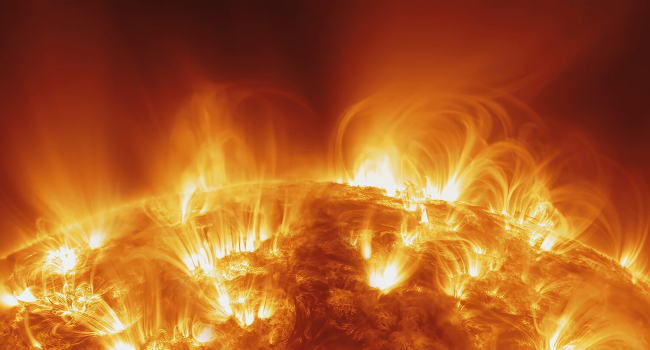
Scientists discover tiny whirlpools on the Sun that could affect Earth
Astrophysicists have identified microscopic whirlpool-like structures on the Sun that may play a significant role in heating the star's outer atmosphere and building up energy for powerful flares, CNN reports, citing a new study.
What researchers found
Tiny vortex structures exist on the Sun's surface. According to the scientists, these may help explain one of the longest‑standing paradoxes: why the corona – the Sun's outer atmosphere – is significantly hotter than its visible surface.
Moreover, these micro‑vortices may contribute to the accumulation of magnetic energy. When this energy is released, solar flares and coronal mass ejections occur.
"The vortices… may contribute to the build‑up of the Sun's magnetic energy. When directed toward Earth, this solar activity ejects particles that can disrupt satellites, power grids and other communications infrastructure," the publication notes.
Why this matters
Solar flares and the associated streams of particles directly affect Earth‑based technologies. They can disrupt satellites, navigation systems, radio communications, and even power grids. Understanding the mechanisms that trigger this activity helps improve space weather forecasting and prepare for potential impacts.
The discovery of micro‑vortices adds a new element to our picture of how the Sun "charges" its atmosphere and releases energy into surrounding space.
In brief
Scientists have discovered tiny vortices on the Sun that may explain why the corona is hotter than the star's surface and how energy for flares accumulates. These structures influence the Sun's magnetic activity, and its consequences – particle streams – can disrupt satellites and ground‑based infrastructure on Earth.
- Related News
- Would a nuclear explosion stop a city-killer asteroid?
- What would a person see if they fell into a black hole?
- A ninth planet may be hiding in the Solar System
- The Roman space telescope will reveal the Universe as Hubble and JWST cannot
- Scientists have learned to predict how muscles will adapt to lunar gravity
- 10,000 tiny probes to Saturn's rings and robots in lunar caves: NASA funds 18 visionary ideas
- Tech Jobs
- Most read
month
week
day
- A deep partial lunar eclipse on 27–28 August: an almost total "Blood Moon" 976
- Google now forces a 24-hour wait before APK installation: Android’s new defense against malware 711
- Earth’s microbes may survive on the Moon. Even a bootprint is enough to shield them 639
- Firebird AI Joins UATE as a Strategic Member 636
- Astronomers have found the fastest star in the Milky Way—it races around a black hole at 8% of the speed of light 623
- Quantum entanglement has been achieved directly from sunlight for the first time 608
- How NASA's primary training centre is changing in the era of commercial space stations 562
- The anniversary iPhone 20 will be as thin as the Air: what the insider revealed 527
- From Excel to AI: A startup by specialists who relocated from Iran to Armenia helps businesses make sense of their data 477
- Robot knocks out teeth of five year old girl: Incident at Chinese museum leads to lengthy compensation dispute 470
- Archive