


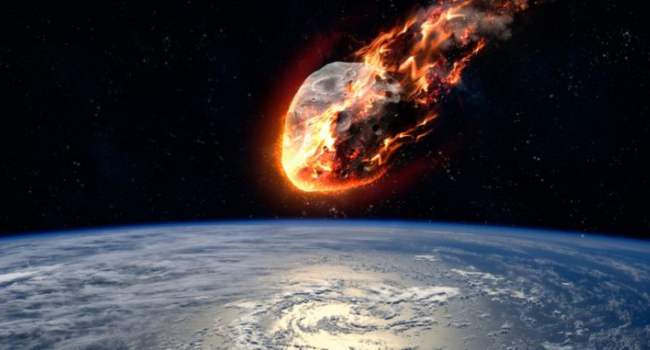
Would a nuclear explosion stop a city-killer asteroid?
If an asteroid the size of a football field were on a collision course with Earth, the consequences could be catastrophic. Even a relatively small space rock, roughly 160 metres in diameter, could completely obliterate a major city. One possible defence option is a nuclear warhead. New research suggests that such an approach could indeed work—though not at all in the way it is commonly imagined.
Why a Nuclear Blast Is Not a Simple Impact
For a long time, the idea of "blowing up an asteroid" seemed straightforward: land a warhead on the surface, or even bury it inside, and detonate. In practice, the reality is far more complicated. Asteroids rotate and tumble, and landing a probe on one—let alone keeping it in place—is extremely difficult.
A team of researchers led by Isaiah Santistevan of Lawrence Livermore National Laboratory decided to test a different scenario. They modelled the detonation of a one-megaton warhead not on the surface, but several metres away from an asteroid 160 metres in diameter. As a baseline, they used the shape and porous structure of the real asteroid Bennu, on which a NASA spacecraft touched down in 2020.
X-Rays Do the Heavy Lifting
In space, there is virtually no medium to transmit a shock wave. The primary effect of a nuclear explosion therefore plays out differently. About 70–80% of the energy from a nuclear warhead is released in the form of an intense flux of X-ray radiation.
These X-rays heat a thin surface layer of the asteroid, causing it to vaporise and ablate. The vaporised material expands rapidly outward. If its speed exceeds the asteroid's escape velocity, that material flies off and imparts momentum to the remaining body—altering its speed and trajectory.
At the same time, the X-ray pulse generates a powerful shock wave within the rock itself. This wave fractures and shatters the material from the inside. It was this fragmentation effect that particularly interested the researchers: in some cases, simply deflecting the asteroid may not be enough, and its disintegration may be required.
What the Simulations Showed
The scientists conducted several detailed three-dimensional calculations with different detonation distances—10 and 25 metres—and with different material strength models based on real meteorites.
In one scenario, with a detonation 10 metres from the surface, 98.2% of the asteroid's material was completely damaged within 145 milliseconds of the explosion, and about 97% of the mass was moving faster than escape velocity. Moreover, large fragments flew off in opposite directions—the asteroid effectively came apart.
An unexpected result came from the detonation at 25 metres. Although less energy reached the asteroid, the X-rays illuminated a larger surface area. As a result, the damage was more extensive than with the closer detonation at the same stage of the simulation. This suggests that "closer is better" is not always the rule.
Limitations of the Study
The simulations proved extremely resource-intensive. The longest calculation, covering only 145 milliseconds of the process, took 59 days of computation time across 1,680 processors. Because of this, the researchers could not track the subsequent fate of the debris.
Various outcomes remain possible: fragments could disperse harmlessly; some could remain large enough to pose a threat; or the asteroid could reaccumulate under its own gravity. These questions require further investigation.
Nevertheless, the work represents an important step in evaluating the nuclear option for planetary defence. It demonstrates that a standoff detonation using X-ray radiation can indeed seriously damage or destroy a city-killer-sized asteroid.
The findings are published in The Planetary Science Journal.
In Brief
US scientists modelled the detonation of a one-megaton nuclear warhead near a 160-metre-diameter asteroid. It is not the shock wave but X-ray radiation that plays the dominant role: it vaporises the surface while simultaneously fracturing the rock from within. In several scenarios, destruction proved highly probable, with detonation at a greater distance sometimes producing more extensive damage. The long-term fate of the debris remains unclear, but the study confirms that the nuclear option for defending Earth against hazardous asteroids could be viable.
- Related News
- What would a person see if they fell into a black hole?
- A ninth planet may be hiding in the Solar System
- The Roman space telescope will reveal the Universe as Hubble and JWST cannot
- Scientists have learned to predict how muscles will adapt to lunar gravity
- 10,000 tiny probes to Saturn's rings and robots in lunar caves: NASA funds 18 visionary ideas
- 20 years without planet status: Will Pluto get its title back?
- Tech Jobs
- Most read
month
week
day
- A deep partial lunar eclipse on 27–28 August: an almost total "Blood Moon" 947
- Google now forces a 24-hour wait before APK installation: Android’s new defense against malware 706
- Earth’s microbes may survive on the Moon. Even a bootprint is enough to shield them 634
- Firebird AI Joins UATE as a Strategic Member 633
- Astronomers have found the fastest star in the Milky Way—it races around a black hole at 8% of the speed of light 621
- Quantum entanglement has been achieved directly from sunlight for the first time 605
- How NASA's primary training centre is changing in the era of commercial space stations 558
- The anniversary iPhone 20 will be as thin as the Air: what the insider revealed 495
- Robot knocks out teeth of five year old girl: Incident at Chinese museum leads to lengthy compensation dispute 447
- From Excel to AI: A startup by specialists who relocated from Iran to Armenia helps businesses make sense of their data 428
- Archive