


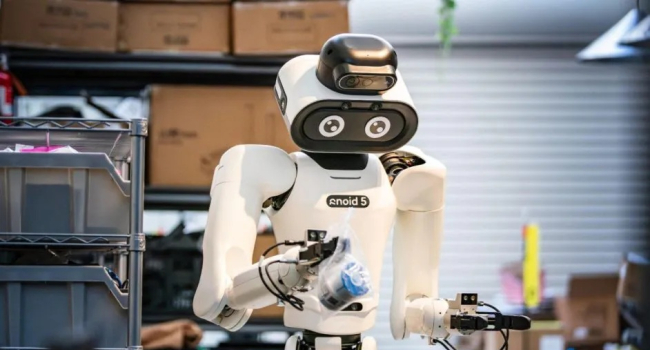
Robot.com introduces R-noid: A wheeled humanoid for warehouses and restaurants
Startup Robot.com (formerly Kiwibot) has announced the launch of R-noid, a new wheeled humanoid robot designed for restaurant kitchens, warehouses, and logistics. The robot is powered by an AI model from Physical Intelligence, The Next Web reports.
The company, which has spent several years successfully operating delivery robots on campuses, is now making a significant move into the industrial manipulator segment. According to CEO Felipe Chávez, the transition to humanoids has been in development for nearly two years.
"We already have a strong foothold with our delivery robots, with over 500 machines in operation and more than 2.5 million completed tasks. Offering manipulation solutions was the logical next step," Chávez noted in a comment to Business Insider.
Legless, but Handed
Unlike most ambitious bipedal humanoids, R-noid stands on a holonomic wheeled platform. This solution allows the robot to be more stable, cheaper to manufacture, and quicker to market, although it deprives it of the ability to climb stairs independently.
The robot is equipped with two 7-degree-of-freedom manipulators, a mobile torso, and can reach a height of nearly two meters. A vision-language-action model by Physical Intelligence—one of the most prominent robotics labs recently—is responsible for the precision and dexterity of its movements. The model understands standard language commands, "sees" the environment, and independently plans arm movements.
Navigation and autonomous movement are provided by a partner company, FieldAI.
First Results and Future Plans
Currently, Robot.com has deployed fewer than 40 R-noid robots across approximately 12 clients. One notable case study is the Harbor Links Golf Course in New York, where the robot helps load food into delivery units and pack orders.
Deploying a single robot takes between 8 and 12 weeks. The process includes a facility audit, task selection, and data collection to fine-tune the AI. According to Chávez, some operations require up to 50 hours of telemetry before the robot can operate independently.
At the initial stage, the autonomy level is around 70%, with the remainder handled by telepresence and remote operator support. The company emphasizes that the goal is not to replace employees, but to relieve them of heavy, monotonous work.
Currently, R-noid is being launched in five main scenarios: restaurant kitchen assistant, packer, order picker, folder, and host.
Realism Amid the Hype
Robot.com is deliberately positioning R-noid as a practical, highly specialized tool rather than a universal "jack-of-all-trades robot." This is a crucial distinction against the backdrop of an overheated humanoid market: by various estimates, there are more than 150 companies operating in the segment, yet real customer satisfaction in the enterprise sector remains low.
The company was founded in 2017 as Kiwibot and rebranded in October 2025. Its investors include Headline, Sodexo VC, and the UC Berkeley SkyDeck Fund. The public debut of R-noid will take place at the Automate 2026 expo in Chicago this week.
- Related News
- Beijing opens "Kindergarten" for robots: Machines learn from their own mistakes
- Robot knocks out teeth of five year old girl: Incident at Chinese museum leads to lengthy compensation dispute
- Humanoid robots could appear on the US border: company has already shown the technology to law enforcement
- Molecule-sized technologies։ How nanorobots are reshaping medicine
- Morgan Stanley nearly doubles China humanoid robot forecast
- AI-powered robots could pose a threat: Researchers warn of new risks
- Tech Jobs
- Most read
month
week
day
- Top tablets of August 2026: Experts name the best five 1725
- Top flagships of August 2026: Experts name the five best smartphones 1586
- 50,000 subscriptions and AI for schools: How Armenia plans to use artificial intelligence in education 873
- Samsung unveils monitor with record-breaking 1100 Hz refresh rate 733
- Two comets will be visible in Autumn 2026 730
- WhatsApp to introduce full passwords instead of PIN codes 659
- Foldable iPhone appeals to almost no one: Three-quarters of Americans don't want one 621
- A simple way to spend less time on your phone: Choosing your own goals? 608
- Would a nuclear explosion stop a city-killer asteroid? 601
- How to work with neural networks properly: 5 rules that actually help 587
- Archive