


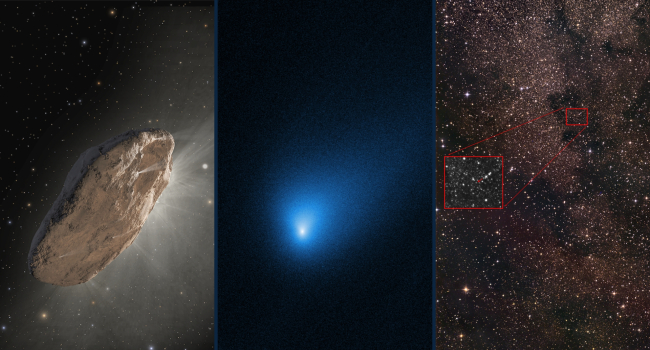
Could interstellar object 3I/ATLAS be an alien technology?
On July 1, 2025, the ATLAS telescope in Chile detected the third known interstellar object, named 3I/ATLAS (or C/2025 N1), which is traveling through the Solar System at a speed of about 60 km/s. Presumed to be a comet, the object caught the attention of scientists due to its unusual characteristics, sparking speculation about its possible artificial origin. A team of researchers, including Harvard’s Avi Loeb, suggested that 3I/ATLAS might be a technological artifact, possibly equipped with active intelligence. However, this idea has been met with sharp criticism in the scientific community, and most experts lean toward a natural origin for the object.
In this article, we review the hypothesis, criticisms, and current data on 3I/ATLAS based on available sources.
It is worth noting that claims linking the research to Cornell University are not supported by available data. The study in question was published by Avi Loeb in collaboration with Adam Hibberd and Adam Crowl of the UK-based Initiative for Interstellar Studies (i4is).
Characteristics of 3I/ATLAS
The object 3I/ATLAS was discovered on July 1, 2025, by the ATLAS system in Chile at a distance of 4.5 astronomical units (about 670 million km) from the Sun. Its hyperbolic trajectory indicates interstellar origin — it is not gravitationally bound to the Sun and will exit the Solar System after passing perihelion (its closest approach to the Sun) on October 30, 2025, at about 210 million km, slightly inside the orbit of Mars. It will pass near Earth in December 2025 at a distance of around 270 million km, posing no threat.
Key characteristics of 3I/ATLAS:
- Speed: Around 60 km/s (245,000 km/h), making it the fastest known interstellar object.
- Size: Estimates vary. Initial brightness suggested a diameter of about 20 km, but observations from the Vera Rubin Observatory refined this to about 11.2 km (7 miles), making it the largest of the three known interstellar objects (1I/ʻOumuamua and 2I/Borisov were much smaller).
- Cometary activity: Observations starting July 2, 2025 (from telescopes in Chile, Arizona, and Hawaii), showed a faint coma and a short tail about 25,000 km long, confirming its classification as a comet. The coma’s reddish color (B–V = 0.98) indicates dust, similar to 2I/Borisov.
- Trajectory: A retrograde orbit inclined at 175.1° to the ecliptic, nearly aligned with Earth’s orbital plane (with a random occurrence probability of 0.2%). The object will pass close to Venus (0.19 AU), Mars (0.12 AU), and Jupiter (0.65 AU), with a combined probability of about 0.005%.
These features — especially size, speed, and trajectory — have stirred scientific interest and debate.
Hypothesis of Alien Technology
Avi Loeb, known for his theories on the alien origin of objects like ʻOumuamua, co-authored a paper (unpeer-reviewed) on arXiv with researchers from i4is suggesting that 3I/ATLAS could be a technological artifact, possibly with active intelligence. The hypothesis rests on several anomalies:
- Trajectory: The retrograde orbit near the ecliptic and close flybys of Venus, Mars, and Jupiter with less than 0.005% probability suggest possible “intentional” motion. Loeb proposes the object might perform an Oberth maneuver (acceleration or deceleration at perihelion) to remain in the Solar System — behavior characteristic of spacecraft.
- Size: The initial estimate of a 20 km diameter is unusually large for an interstellar object. Loeb argues the chance of discovering such a large object (compared to ʻOumuamua) is just 0.0001, making it anomalous.
- Lack of early cometary activity: Initial spectra showed no molecular gas, which is atypical for comets, although later observations confirmed the presence of a coma and tail.
- Stealth: 3I/ATLAS will be hidden behind the Sun from Earth’s perspective during perihelion. According to Loeb, this could be intentional, allowing a maneuver to occur undetected.
Loeb references the "Dark Forest" hypothesis (popularized in Liu Cixin’s novel), which suggests extraterrestrial civilizations may hide to avoid mutual destruction. In this context, 3I/ATLAS could be a probe studying the Solar System. The authors stress their hypothesis is a pedagogical exercise, and that a natural explanation remains most likely.
Loeb outlines two scenarios:
- Benevolent: If 3I/ATLAS is an alien probe, it may be peaceful, and humanity should welcome it “with open arms.”
- Hostile: If the object is hostile, defensive measures might be needed — though Loeb acknowledges these would likely be ineffective.
The hypothesis suggests that non-gravitational maneuvers between November 21 and December 5, 2025, could indicate artificial origin.
Criticism of the Hypothesis
Loeb’s hypothesis has been sharply criticized by the scientific community:
- Natural origin: Samantha Lawler, professor of astronomy at the University of Regina, stated that 3I/ATLAS is a typical comet ejected from another stellar system — a common occurrence. July 2025 observations (from Gemini North, the Nordic Optical Telescope, and others) confirmed a coma and tail, countering the claim of no cometary activity.
- Lack of evidence: Richard Moissl from the European Space Agency (ESA) noted that all observations indicate a natural object with faint cometary activity. There is no sign of non-gravitational acceleration (like with ʻOumuamua), and spectral data supports a cometary origin.
- Statistical reasoning: Lawler and others argue the trajectory and size are not anomalous. Interstellar comets can be large, and their paths are governed by random factors in their home systems. A 0.2% orbital probability is not exceptional.
- Loeb’s reputation: Loeb is known for controversial theories, including the alien origin of ʻOumuamua. Many peers view his ideas as sensational and requiring “extraordinary evidence,” which remains lacking.
ESA and NASA have classified 3I/ATLAS as a comet based on data from multiple observatories, including Vera C. Rubin, Gemini North, and Hubble. The object shows no signs of artificial origin, such as radio signals or unusual maneuvers.
Scientific Context and Future Prospects
3I/ATLAS is the third known interstellar object after 1I/ʻOumuamua (2017) and 2I/Borisov (2019). Studying it is important for understanding the composition and origins of interstellar bodies. Scientists like Matthew Hopkins of Oxford University suggest that 3I/ATLAS could be older than Earth (up to 7 billion years) and may contain water ice from the Milky Way’s thick disk.
Current and future observations:
- Telescopes: The James Webb Space Telescope (JWST) and Hubble are already observing the object. The Vera Rubin Observatory, operational since 2025, provided the size estimate (7 miles). By October 2025, the comet is expected to brighten, allowing further analysis.
- Missions: A probe launch to 3I/ATLAS is unfeasible due to its speed and distance, but ESA’s Comet Interceptor mission (2029) may target future interstellar visitors.
- Key dates: Perihelion on October 30, 2025, and closest approach to Earth in December 2025 (270 million km) will provide more data. If anomalous maneuvers are observed, Loeb’s hypothesis might gain support, but that remains unlikely.
What Conclusions Can Be Drawn?
The hypothesis that 3I/ATLAS is alien technology is based on its unusual trajectory, size, and initially presumed lack of cometary activity. However, these arguments are refuted by observations confirming that it is a comet with a ~11.2 km nucleus, coma, and tail. Most scientists, including Samantha Lawler and ESA representatives, consider 3I/ATLAS a natural object ejected from another star system. Loeb and his coauthors acknowledge their hypothesis is a pedagogical exercise and that a cometary nature is the most likely explanation.
The absence of evidence for artificial origin — such as radio signals or maneuvers — and confirmed cometary activity make Loeb’s theory improbable. Nonetheless, 3I/ATLAS remains a valuable target for research and may reveal clues about interstellar space. Further observations between October and December 2025 will clarify its nature, and while the alien scenario captures the imagination, the scientific community insists on “extraordinary evidence” for such extraordinary claims.
- Related News
- Would a nuclear explosion stop a city-killer asteroid?
- What would a person see if they fell into a black hole?
- A ninth planet may be hiding in the Solar System
- The Roman space telescope will reveal the Universe as Hubble and JWST cannot
- Scientists have learned to predict how muscles will adapt to lunar gravity
- 10,000 tiny probes to Saturn's rings and robots in lunar caves: NASA funds 18 visionary ideas
- Tech Jobs
- Most read
month
week
day
- A deep partial lunar eclipse on 27–28 August: an almost total "Blood Moon" 934
- Google now forces a 24-hour wait before APK installation: Android’s new defense against malware 705
- Earth’s microbes may survive on the Moon. Even a bootprint is enough to shield them 632
- Firebird AI Joins UATE as a Strategic Member 631
- Astronomers have found the fastest star in the Milky Way—it races around a black hole at 8% of the speed of light 621
- Quantum entanglement has been achieved directly from sunlight for the first time 598
- How NASA's primary training centre is changing in the era of commercial space stations 549
- The anniversary iPhone 20 will be as thin as the Air: what the insider revealed 467
- Robot knocks out teeth of five year old girl: Incident at Chinese museum leads to lengthy compensation dispute 430
- How to make your new smartphone more secure: expert tips 410
- Archive