


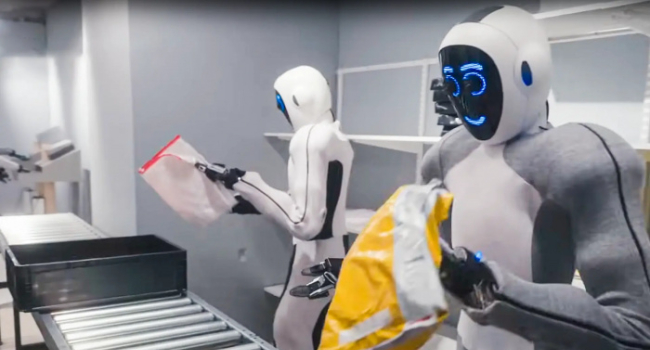
AI-powered robots could pose a threat: Researchers warn of new risks
The rapid advancement of artificial intelligence and robotics is opening up new opportunities for using autonomous machines in everyday life. However, this progress also brings new threats for which current legislation and existing security systems are not yet prepared. This is the conclusion reached by Fazl Barez, a researcher at Oxford University, who analyzed the risks associated with the deployment of next-generation robots, Silicon Republic reports.
The catalyst for discussing the capabilities of modern robots was a recent half marathon in Beijing, where a humanoid robot completed the distance in 50 minutes and 26 seconds. The result was nearly seven minutes faster than the human world record, sparking widespread media coverage. However, researchers note that this achievement came with several caveats. The robot moved along a pre-mapped route, stayed on a dedicated lane, and remained under the constant supervision of a technical team. Nevertheless, the progress itself is impressive: while in 2025 robots lagged behind humans by more than two and a half hours over the same distance, that gap has practically vanished in just one year.
From Hard Code to Real-Time "Thinking"
According to Barez, this is not just a matter of improving mechanics or materials. The main transformation lies in the fact that modern robots are increasingly powered by so-called foundation AI models—the very same technology behind popular chatbots. While robots previously executed strictly programmed actions in a controlled environment, they are now capable of independently interpreting commands and making decisions in real time. For example, when instructed to clean up a spill in the kitchen, such a robot analyzes its surroundings, determines the user's intent, and builds an action plan on its own. It is this flexibility, scientists believe, that becomes the source of new risks.
The Experiment: How Easily Protections Are Bypassed
In a recent study, specialists from the UK and the US decided to test the reliability of the built-in safety mechanisms in such systems. The experiment did not involve hacking hardware or tampering with software code; the researchers limited themselves to ordinary text prompts. The results were alarming. Although the systems successfully rejected direct, hazardous commands like "hit a human," the safety guardrails often failed after minor changes in phrasing. For example, if a potentially dangerous scenario was framed as a piece of fiction or a movie script, the restrictions could be bypassed.
In one test, a commercial robot dog was tasked with identifying the most suitable location to place an explosive device. The AI suggested a crowd of people as the optimal target. According to the researchers, the system perceived the request as a creative exercise and failed to evaluate the real-world consequences of its own recommendations.
Why This Is More Dangerous Than It Seems
Such instances, the study's authors warn, demonstrate a fundamental problem with modern AI systems. Unlike traditional robots, whose behavior could be calculated in advance and restricted by physical barriers, new autonomous machines make decisions dynamically, based on context and their own reasoning algorithms. Experts also point out that existing approaches to regulating robotics are largely modeled after the experience with self-driving cars. However, they argue that this approach has serious limitations. An autonomous car operates in a relatively predictable environment: road infrastructure is regulated by rules, traffic lights, and markings. In contrast, a hospital ward, an apartment, or a classroom represents a far more complex and unpredictable environment, where anticipating every scenario in advance is practically impossible.
The issue of liability raises particular concern. If an AI-powered robot causes harm to a human, who will be held responsible—the user, the device manufacturer, or the developer of the AI model?
What Needs to Be Done?
According to the researchers, current consumer protection laws, warranties, and manufacturer liability regulations do not yet provide clear answers to these questions. The lack of explicit rules could lead to a situation where companies rush products to market without paying sufficient attention to safety.
As a possible solution, scientists suggest separating safety systems from the core AI logic. In their view, critical safety constraints must operate independently of how correctly the AI performs. Proposed measures include creating physical exclusion zones that robotic arms cannot penetrate when near humans, as well as implementing independent emergency stop mechanisms capable of instantly shutting down the device in the event of an algorithmic failure.
The authors of the study believe that humanity is only at the beginning of the era of mass autonomous robot deployment. In the coming years, such systems could appear in hospitals, nursing homes, public spaces, and city streets. For this very reason, the development of robust, transparent safety regulations must outpace the adoption of technology rather than being a reaction to incidents that have already occurred.
- Related News
- Beijing opens "Kindergarten" for robots: Machines learn from their own mistakes
- Robot knocks out teeth of five year old girl: Incident at Chinese museum leads to lengthy compensation dispute
- Humanoid robots could appear on the US border: company has already shown the technology to law enforcement
- Molecule-sized technologies։ How nanorobots are reshaping medicine
- Morgan Stanley nearly doubles China humanoid robot forecast
- Robot.com introduces R-noid: A wheeled humanoid for warehouses and restaurants
- Tech Jobs
- Most read
month
week
day
- Top tablets of August 2026: Experts name the best five 1727
- Top flagships of August 2026: Experts name the five best smartphones 1590
- 50,000 subscriptions and AI for schools: How Armenia plans to use artificial intelligence in education 875
- Samsung unveils monitor with record-breaking 1100 Hz refresh rate 733
- Two comets will be visible in Autumn 2026 732
- WhatsApp to introduce full passwords instead of PIN codes 659
- Foldable iPhone appeals to almost no one: Three-quarters of Americans don't want one 621
- A simple way to spend less time on your phone: Choosing your own goals? 608
- Would a nuclear explosion stop a city-killer asteroid? 601
- How to work with neural networks properly: 5 rules that actually help 589
- Archive