


Light-based Chip Boosts AI Power Efficiency Up to 100-Fold
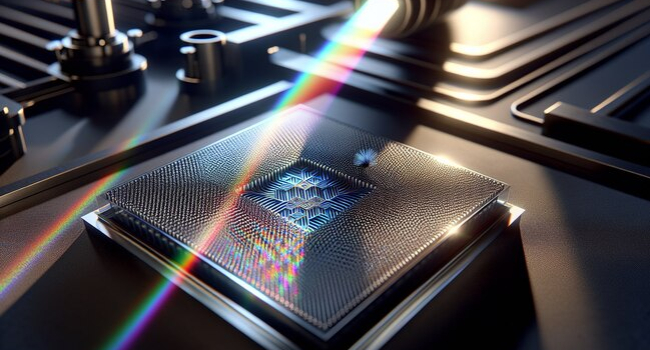
A University of Florida team has created a new chip that uses light alongside electricity to handle power-intensive AI tasks like image recognition, achieving 10 to 100 times better efficiency than current chips. This could reduce the strain on power grids from AI's growing electricity demand while enhancing model performance, reports Techxplore.
AI systems, vital for facial recognition and translation, consume vast energy as they grow complex, challenging sustainability. The new chip tackles this by using light for convolution operations—key to pattern detection in images and text—integrating optical components on a silicon chip with laser light and microscopic lenses to cut energy use and boost speed.
Volker J. Sorger, the study leader, called it a "leap forward" for energy-efficient AI, noting the prototype achieved 98% accuracy in digit classification using miniature Fresnel lenses etched onto the chip. The process converts data into light, performs transformations via lenses, and converts results back to digital signals.
Co-author Hangbo Yang highlighted the chip's ability to process multiple data streams simultaneously using different laser colors (wavelength multiplexing), a key photonic advantage. Collaborating with the Florida Semiconductor Institute, UCLA, and George Washington University, the team sees this as a step toward integrating optical AI into everyday chips, with manufacturers like NVIDIA potentially adopting it soon.
- Related News
- 50,000 subscriptions and AI for schools: How Armenia plans to use artificial intelligence in education
- How to work with neural networks properly: 5 rules that actually help
- Why Bill Gates is no longer an AI optimist: Three major threats of AI
- Firebird AI Joins UATE as a Strategic Member
- Neural networks can't read minds: 4 key rules for working effectively with AI
- OpenAI prepares to go public in 2027
- Tech Jobs
- Most read
month
week
day
- Top tablets of August 2026: Experts name the best five 984
- Top flagships of August 2026: Experts name the five best smartphones 865
- From Excel to AI: A startup by specialists who relocated from Iran to Armenia helps businesses make sense of their data 853
- The anniversary iPhone 20 will be as thin as the Air: what the insider revealed 711
- Why Bill Gates is no longer an AI optimist: Three major threats of AI 648
- Robot knocks out teeth of five year old girl: Incident at Chinese museum leads to lengthy compensation dispute 596
- How NASA's primary training centre is changing in the era of commercial space stations 591
- 10,000 tiny probes to Saturn's rings and robots in lunar caves: NASA funds 18 visionary ideas 584
- Apple prepares to raise iPhone prices following Samsung and Google 555
- 20 years without planet status: Will Pluto get its title back? 506
- Archive