make preferable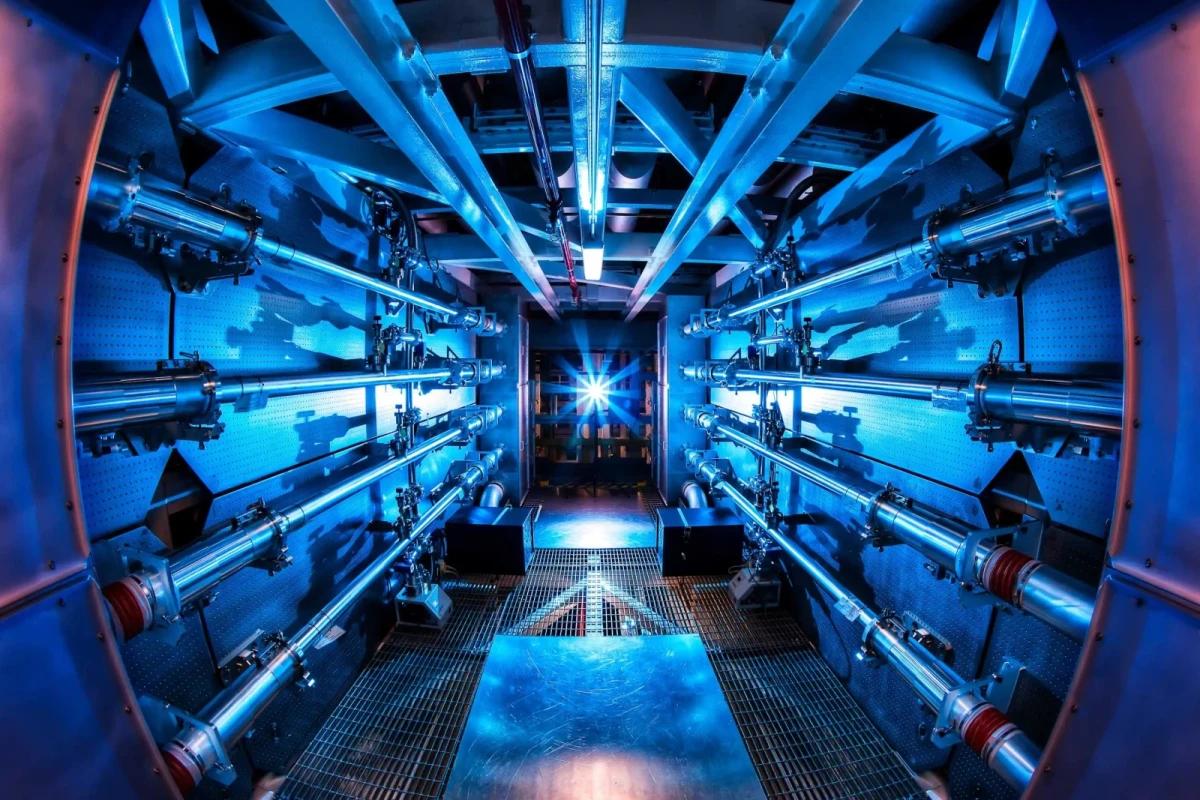
U.S. company Cambridge Heavy Industries is developing a compact controlled fusion system that fits on a laboratory bench. Instead of the many high-power lasers used in other inertial confinement setups, the system uses two main lasers and a special sequence of light pulses to compress the fuel target.
The startup operates out of a small laboratory near the Massachusetts Institute of Technology (MIT) and recently raised $6.2 million in seed funding. In the long term, the company hopes to build a power plant based on its technology, but before that it plans to focus on producing tritium, a rare hydrogen isotope needed by many fusion reactors now under development.
Why a fusion reactor needs a tabletop form factor
Fusion is usually associated with large research complexes, powerful magnets, or laser systems. Cambridge Heavy Industries has chosen a different approach: its current setup is small enough to run experiments in a lab without building massive infrastructure.
According to co-founder and CEO Yun Kai, the compact modular design makes it possible to conduct 50 to 80 experimental shots per day. This allows the team to quickly test different system parameters, compare results, and refine the design.
The company intends to use the data it gathers for computer modeling with artificial intelligence. The algorithms are expected to help optimize the device and speed up the search for the most efficient operating modes.
Cambridge Heavy recently raised $6.2 million in a seed round led by Azolla Ventures. Overlay, Neta Foundation, P3A, MassCEC, and the Rothrock family also joined the financing.
How two lasers help compress fusion fuel
The technology is based on inertial confinement: a fuel target is compressed by powerful laser pulses, creating the conditions for a fusion reaction. This principle has already demonstrated the possibility of obtaining more fusion energy in a controlled experiment than was delivered directly into the fuel. However, that result by itself does not mean the entire system produces more energy than it consumes.
Cambridge Heavy is trying to achieve the necessary conditions with a relatively small number of lasers. The system uses two main lasers, one of which splits its light into several beams. These are directed at a flat circular fuel target in rings.
The pulses do not arrive simultaneously, but in a specific sequence—from the outer rings to the inner ones. The first pulse launches a compression wave moving toward the center of the target. The following pulses are delivered at calculated moments, reinforcing that wave and compressing the fuel further.
When the shock wave reaches the central region, the second laser acts on the target, increasing the temperature and creating a magnetic field. At sufficiently high temperature and pressure, the fuel nuclei can begin to fuse, releasing energy.
According to Kai, the design makes it possible to create high pressure with relatively low laser power. The idea originated in the lab of MIT chemist Keith Nelson, where researchers studied the behavior of materials under extreme conditions. As the pressure increased, the researchers discovered they were approaching the conditions needed for fusion.
For now, this remains an emerging technology: the compact size and frequent experimental runs make research easier, but by themselves they do not prove that the system will be able to deliver economically viable operation for a power plant.
Why the startup wants tritium at $30,000 per gram
Before building a power plant, Cambridge Heavy intends to use its compact systems to produce tritium, a radioactive isotope of hydrogen that is expected to be used in the fuel systems of many fusion reactors.
According to an estimate cited by TechCrunch, tritium currently costs about $30,000 per gram. At the same time, global supplies are extremely limited: according to the publication, only about 40 kilograms of the substance currently exist.
A single power plant may require relatively little tritium—on the order of a few grams per year. But if fusion energy begins to scale up, total demand could exceed available supply.
A study cited by TechCrunch projects that, without new sources, the industry could face a shortfall of about 28 kilograms of tritium by 2054. At today’s prices, that would amount to roughly $840 million.
As a result, isotope production could become a separate source of revenue for Cambridge Heavy even before its own power plant appears. That is especially important because developing and scaling fusion technologies takes time.
However, tritium production itself involves technical challenges. The industry is developing fuel systems that would allow reactors to replenish their isotope supplies on their own, although periodic replenishment may still be required. According to Kai, creating such systems could take up to ten years.
A power plant is a goal roughly a decade away
In the long term, Cambridge Heavy plans to build an energy system based on its technology. By Kai’s estimate, that could take about ten years. The future system will be significantly larger than the laboratory prototype but, the company expects, more compact than many other fusion power plant projects. He compared its footprint to roughly two basketball courts.
The main task at that stage will be to verify whether the technology can provide sufficient energy output for a full-scale power plant. Before that, the company will need to solve issues of scaling, reliability, and overall system efficiency.
A compact reactor that can be quickly modified and tested repeatedly gives the startup a way to validate engineering hypotheses faster. And tritium production could potentially help finance further development. But for now, Cambridge Heavy still has to make the transition from a laboratory setup to a system capable of steadily producing useful energy at industrial scale.