make preferable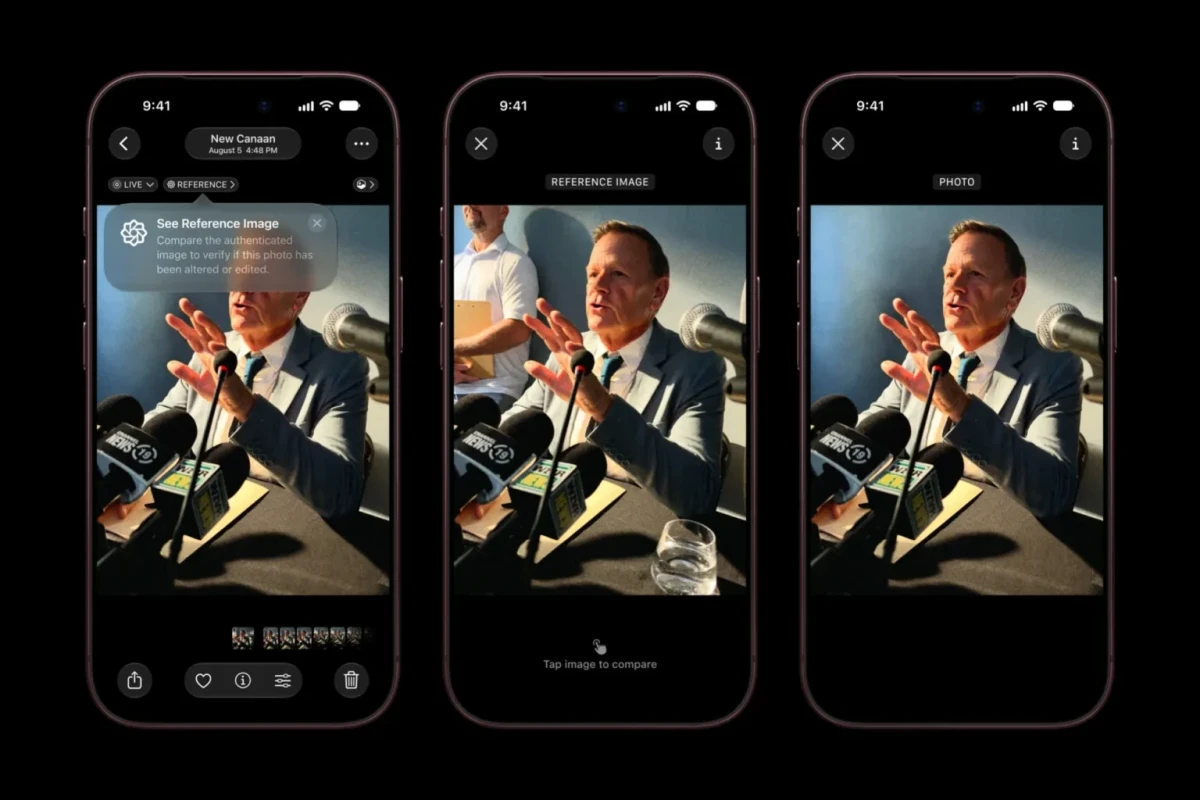
Apple has introduced a new feature called Reference Image, designed to help determine whether a photo has been altered after it was taken. The tool is intended primarily for photographers, photojournalists, and anyone who needs to distinguish real photos from images created or modified with AI.
The feature will be available on the iPhone 18 Pro and Pro Max. Apple presents it as a way to confirm not that the depicted scene fully corresponds to reality, but rather what data the camera captured and whether the photo was changed afterward.
The camera creates a digital original
Reference Image works using a new main camera sensor. When taking a photo, it records signed data for every pixel. The Private Cloud Compute service then transforms that data into a secure image that Apple calls an immutable reference.
In the Photos app, such a file will appear alongside the regular version of the photo. Users will be able to compare the images and determine whether any changes were made. Apple compares Reference Image to a digital negative — the original version of a photograph against which later versions can be matched.
Signed images can be shared with other people together with the data needed for later verification. This means the confirmation is not limited to the single device on which the photo was taken.
At launch, Reference Image will be available directly in the Photos app. Apple is also releasing an API so third-party developers can integrate viewing and verification of reference images into their own apps. Support will arrive in iOS 27, iPadOS 27, and macOS 27.
Protection against AI editing
Apple also announced support for Google’s SynthID standard. It is used to label images created or modified with artificial intelligence.
Support for SynthID is expected to arrive in a software update later this year. It will apply to most edited images, although the result depends on the nature of the changes. In particular, images created using Image Playground and new Apple Intelligence tools such as Extend and Spatial Reframe will contain corresponding markers.
A photo’s metadata and Reference Image signatures can be used together: the former will help identify signs of AI generation or editing, while the latter will verify what data the camera actually captured at the moment the shutter was pressed.
What exactly the feature will be able to prove
Reference Image does not confirm that a photo shows the whole truth. For example, it cannot establish whether a scene was staged, whether the image was taken out of context, or whether it is accompanied by a false description.
The feature is intended to verify an image’s origin and the history of its changes. It can show that a specific version came from the camera and was not subsequently edited, but it does not prove the accuracy of every claim associated with the photo.
This is especially important for news photography: an image may be technically original, yet taken in a staged situation or presented with an incorrect caption.
Limitations at launch
Reference Image will not be available in China. In the European Union, at the initial stages, the ability to shoot in this mode itself will be disabled on iPhone 18 Pro models. At the same time, devices with the appropriate operating system versions will be able to create and view Reference Images if the reference image was obtained by other means.