




 make preferable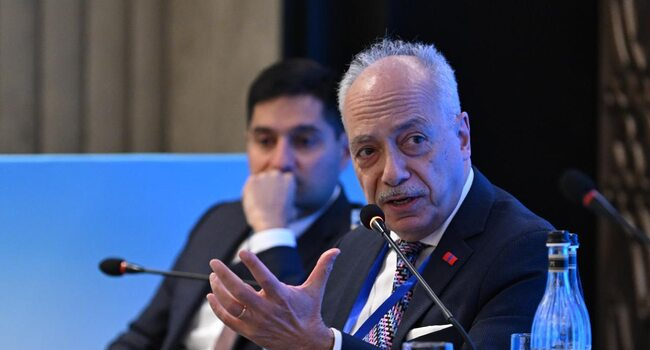
In a world where artificial intelligence is gradually becoming the "invisible infrastructure" of daily life, the key role belongs not to applications or even algorithms, but to the microchips on which it all runs. These chips form the foundation of the new economy. This was stated by Yervant Zorian, Chief Architect and Fellow of Synopsys Armenia, at the Yerevan Dialogue 2026 forum.
According to his assessment, Armenia's role in the global semiconductor industry lies not in manufacturing, but in the authorship of technologies and the supply of specialized resources.
The Era of Pervasive Intelligence
According to Zorian, the world has entered a new phase—the era of "pervasive intelligence." Not only devices but also infrastructures, management systems, transport, and medicine are becoming smart. This new reality has a base layer: semiconductors. "Chips are what give us intelligence," he emphasized. That is why the issue is not only about using technologies but also about the ability to create them.
"Microchip creation is divided into two key stages: design and manufacturing. Both are critically important, but their roles differ," he stated. Zorian offers a simple analogy: a book. There are authors who create the content, ideas, and meaning. And there is the printing house that prints the book. "Armenia is strong specifically in the first part—in creation," he noted. In other words, the country already occupies a niche in chip design—the stage where the intellectual component of the product is formed.
The Role of Minerals: The Hidden Foundation of Technology
However, this does not mean that Armenia cannot participate in the production chain. According to Zorian, modern chips are increasingly dependent on critical minerals. They are necessary for the precision of transistors, data processing speed, and connections between elements in multi-chip modules. Modern processors no longer consist of a single crystal, but of several integrated into complex systems. It is at the level of these connections that critical materials become indispensable. Thus, Armenia can participate in the industry on two levels simultaneously—as a developer and as a supplier of specialized resources.
The Technological Limit: The Angstrom Era
He also drew the participants' attention to the fact that the semiconductor industry continues to grow rapidly in complexity. Today, we are no longer talking about nanometers, but about Angstroms—scales of about one-tenth of a nanometer. This is a level where any further development requires not just engineering solutions, but the constant reinvention of skills. "We must continuously update our knowledge and competencies," Zorian noted.
In Armenia, 14-Angstrom level technologies are already in use—among the most advanced on the market, used by companies like Intel and TSMC. It is expected that through the easing of export restrictions, the country will gain access to even more advanced solutions. "In August of last year, a Memorandum of Understanding on semiconductors and AI was signed between the U.S. government and the government of Armenia. We are grateful for this because it will facilitate export control aspects, and we will be able to bring even more advanced technologies here," he noted.
The Main Resource: People
Despite the complexity of the technology, Zorian places the main emphasis on human capital. "The most important thing is talent," he stressed. But it's not just about people anymore. Today, a new model is forming: Human + AI. In chip design, so-called agents and AI assistants are actively used to help design the most complex systems. A single modern chip can contain up to a trillion transistors—a volume impossible to handle alone. Instead, teams of specialists and multiple AI agents work together, coordinated by humans. The engineer's task is changing: they are becoming not just a developer, but the "conductor" of a complex system.
According to Zorian, Armenia can already act not only as a market participant but also as an example. Specifically, the approaches to personnel training developed at Synopsys Armenia have attracted Europe's attention. A Letter of Intent was signed with the EU, providing for the use of the Armenian training model in creating technological hubs in European countries. This means the country can export not only technology but also a system for specialist training.
The main challenge, according to Zorian, is not to lose momentum. Armenia already possesses the key elements: talent, the presence of international companies, access to technology, and a growing ecosystem. But in conditions where the industry is developing at an unprecedented speed, this is not enough—continuous development is necessary. While countries used to compete for factories, today they increasingly compete for people, knowledge, and the ability to create. It is in this competition that Armenia is seemingly making its main bet.