




 make preferable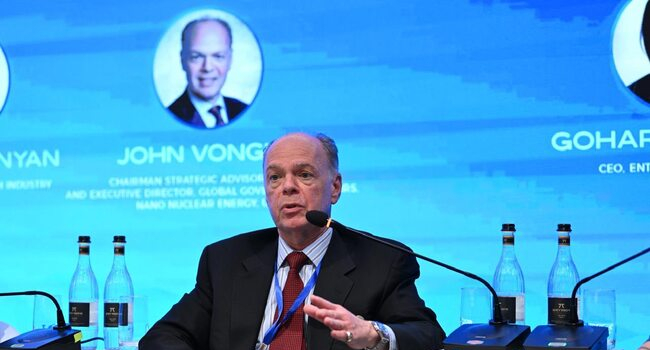
Against the backdrop of growing interest in artificial intelligence, critical minerals, and new supply chains, the question of energy is moving to the forefront. Without sustainable energy, data centers, resource extraction, and high-tech production are impossible.
Speaking at the panel discussion "Critical Minerals, Semiconductors, and the South Caucasus as an Investment Frontier" on the sidelines of Yerevan Dialogue 2026, John Vonglis, Chairman of the Strategic Advisory Board and Executive Director for Global Government Affairs at the U.S. company Nano Nuclear Energy, discussed which energy model he considers viable for Armenia and why microreactors could become a key element of this system.
Energy Without Illusions: The Energy Mix
The first point Vonglis insists on is that there is no single "ideal" energy source. According to him, the only working model is an energy mix. "You use everything: nuclear energy, gas, renewables, hydropower — everything available to move forward," he explains.
The transition to a new energy landscape cannot be instantaneous. It is a gradual, methodical process involving grid modernization and adapting infrastructure to growing loads. And these loads, he says, will only increase: AI infrastructure, mineral extraction and processing, and component manufacturing are all extremely energy-intensive processes.
A key issue is not just generation but the grid itself. Even developed nations, including the U.S., face infrastructure constraints. For countries like Armenia, the task is even more complex: it must simultaneously develop energy capacity and connect new industries. This is where the main question arises: how to provide stable energy where the grid is insufficient or simply non-existent.
Microreactors: Energy as a "Lego" Set
The answer, according to Vonglis, could be microreactors — a new category of nuclear installations. Unlike large nuclear power plants or even small modular reactors (SMRs), they offer several advantages: Autonomy — they do not require mandatory connection to a central grid; Scalability — capacity can be "added" as needed; Reliability and safety; Ability to be deployed in remote areas.
"We like to compare them to Lego: if you need more energy, you just add another block," he says. This model is particularly important for mining regions or new industrial sites lacking developed infrastructure. Furthermore, microreactors can replace diesel generation, which is more expensive and environmentally damaging.
Vonglis added that nuclear energy is still undervalued. According to him, it is one of the cleanest and most stable energy sources. He believes nuclear power can become the foundation for developing new industries — from AI to rare earth element processing. "The question is whether Armenia can reach the point where it becomes part of the Western supply chain for advanced nuclear energy or advanced energy fuels and components," he noted.
Armenia as Part of the Energy Chain
In a broader context, Vonglis views Armenia not just as an energy consumer but as a potential link in a global chain: energy — mineral extraction — processing — high-tech manufacturing. Partnerships play a key role here — from tech companies like Nvidia to infrastructure projects like Firebird.
According to Vonglis, critical minerals today are a matter of national security. In this context, he believes Armenia should act as a bridge to ensure energy security and diversify the supply of minerals and rare earth elements "bypassing competitors and bad actors."
Nuclear Agreements: A Signal to the Market
Vonglis highlights two key events shaping the region's new reality: TRIPP and the "123 Agreement" for cooperation in the nuclear sector. The latter opens doors for technology transfer and investment in nuclear energy. He estimates the total volume of potential funding could reach nearly $10 billion.
"The signed '123' agreement opens opportunities for the commercial application of nuclear technologies, their transfer, and all accompanying support... In total, we are talking about nearly ten billion dollars over the entire term. This is a very, very positive signal in terms of stability in the region," he noted.