make preferable
OpenAI has introduced a new language model, o1, which has the capability for reasoning and logical problem-solving. Unlike previous models, o1 can mimic human thought processes by breaking down complex tasks into simpler steps, analyzing various approaches, and correcting its own mistakes.
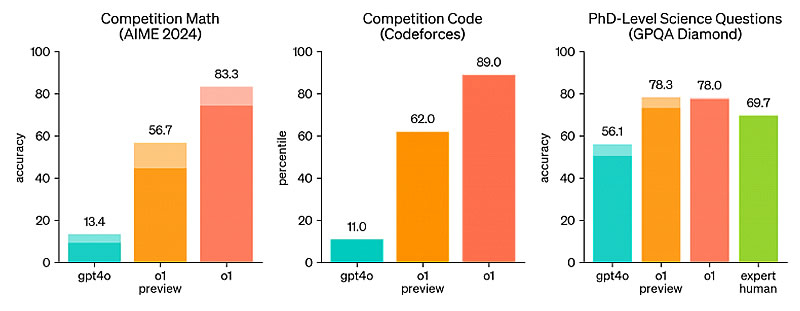
The large language model (LLM) o1 has demonstrated exceptional performance in tests and competitions, comparable to that of experts. In programming, o1 ranked 49th at the 2024 International Olympiad in Informatics (IOI) and outperformed 89% of individuals on the Codeforces platform. In mathematics, o1 ranked among the top 500 students in the U.S. at the qualifying stage of the American Mathematics Olympiad (AIME), showcasing its ability to solve problems designed for highly gifted students, according to OpenAI's website.
In the natural sciences, the model surpassed the performance of PhDs and candidates of sciences in the challenging GPQA diamond test, which evaluates knowledge in chemistry, physics, and biology. "This does not mean that o1 is smarter than any PhD," the developers explain. "It means that the model can solve some problems at the level of highly qualified specialists."
The o1 model also outperformed previous models in various intelligence and problem-solving tests, including MMMU and MMLU. According to OpenAI, the new model significantly surpasses the previous version, GPT-4o, on most logical reasoning tasks. "Our tests showed that o1 consistently improves results with increased reinforcement learning and time spent reasoning," the company notes. Specifically, in AIME tests, the o1 model solved an average of 83% of problems, while GPT-4o solved 13%.
The o1 model makes significantly fewer mistakes compared to GPT-4o. However, it is slower and more expensive. Additionally, o1 falls short of GPT-4o in encyclopedic knowledge and cannot process web pages, files, and images. Moreover, the new model can manipulate data to fit the desired result.
The secret to its success lies in a fundamentally new training algorithm — the "chain of thoughts." The model can enhance this chain by learning through reinforcement learning, which allows it to recognize and correct its errors, break down complex steps into simpler ones, and try various approaches to problem-solving. This methodology greatly improves the model's reasoning ability, allowing it to, like a human, spend considerable time reflecting before answering complex questions.
OpenAI has already released a preview version of the model, o1-preview, available for use in ChatGPT and for developers through an API. The company acknowledges that there is still much work to be done to make o1 as user-friendly as current models. The new model's safety and ethics are also emphasized, as its reasoning can be monitored to prevent potentially undesirable behavior. Before releasing o1-preview for public use, OpenAI conducted safety tests.
The cost of using o1-preview is $15 per million input tokens and $60 per million output tokens. In comparison, GPT-4o offers a price of $5 per million input tokens and $15 per million output tokens.