


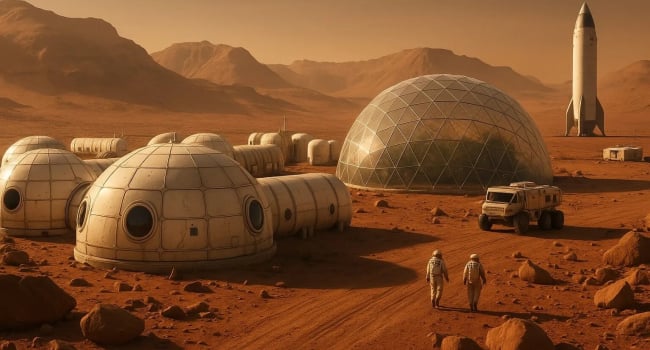
Mars as a second home: what humanity will need to create a colony on the Red Planet
Talk of colonizing Mars has long moved beyond the realm of science fiction. However, establishing a permanent human settlement on the Red Planet is not a matter of a single powerful spacecraft or a lucky landing. It requires creating a virtually autonomous civilization capable of extracting water and raw materials, generating power, producing food, protecting people from radiation and cold, and, most importantly, functioning without constant assistance from Earth.
This comprehensive approach is precisely what researcher Florian Neukart proposes in his paper Towards Sustainable Horizons: A Comprehensive Blueprint for Mars Colonization. At the heart of his analysis is not so much the idea of landing humans on Mars, but rather how to make a human presence there sustainable, safe, and economically viable.
A planet where humans cannot simply step outside
The main problem with Mars is that practically none of its natural parameters are suitable for human life.
The atmospheric pressure on Mars averages around 600 pascals, which is less than 1% of the average sea-level pressure on Earth. The atmosphere consists of roughly 95% carbon dioxide, while oxygen, which humans need to breathe, is practically absent. Direct human exposure to such conditions is lethal.
The situation is further complicated by temperature. At the equator, daytime temperatures can rise to about 20°C, but plunge to −73°C at night. In the polar regions, winter temperatures can reach −125°C. Due to its thin atmosphere, Mars retains heat poorly, so temperature swings create problems not only for humans, but for machinery as well.
There is another distinct feature: a Martian year lasts 687 Earth days, making seasons significantly longer than on Earth. For a future colony, this means power supplies and stockpiles must be calculated not just for individual days, but for extended periods of harsh conditions.
Radiation: an invisible threat to early settlers
One of the most serious obstacles will be radiation. Unlike Earth, Mars lacks a global magnetic field, and its atmosphere is far too thin to shield against cosmic and solar radiation. The primary hazards will be galactic cosmic rays and particles ejected by the Sun during solar flares and coronal mass ejections.
According to data cited in the study, measurements from the Radiation Assessment Detector on the Curiosity rover showed that during a round trip with a stay on the surface, an astronaut could receive a dose of at least 0.66 sieverts. The paper notes that this is more than three times the recommended career limit for radiation exposure for an astronaut.
As a result, Martian housing will likely look vastly different from traditional concepts of a space base. One of the most obvious options is placing a significant portion of the infrastructure underground.
Underground cities instead of surface shelters
Martian soil itself could serve as a protective material. A few meters of regolith and rock can significantly reduce exposure to cosmic radiation while shielding living quarters from extreme temperature fluctuations. Underground structures can also lower the energy costs needed for heating and cooling.
This is why the concept of underground settlements is viewed as one of the most promising avenues for long-term colonization.
However, building such a city will require solving a whole set of new challenges. Technologies must be developed on Mars for drilling and tunneling, circulating air, and maintaining a safe interior environment. Furthermore, permanent life underground could carry psychological consequences. Among potential solutions, the study notes virtual windows, communal areas with simulated natural light, and regular surface outings.
Thus, an underground city would need to serve simultaneously as a shelter, a living space, a manufacturing complex, and a life-support system.
Martian concrete will have to be made from Mars itself
Transporting construction materials from Earth to build a full-scale city is economically impractical. Therefore, a core principle of the future colony is to use what is already available on Mars.
One proposed solution is so-called Martian concrete. Regolith—a mixture of dust, soil, and crushed rock—can serve as the primary raw material. The study explores an option where sulfur acts as a binding agent: when heated, it becomes liquid, mixes with regolith, and then solidifies. Experiments with Martian soil simulants have demonstrated a strength comparable to standard concrete.
The advantage of such technology is clear: the more building materials produced directly on Mars, the less cargo needs to be shipped from Earth.
Yet the technology is not without drawbacks. The study specifically highlights issues regarding the toxicity of certain sulfur compounds, thermal conductivity, and relatively weak tensile strength. Thus, this is not a ready-to-use construction standard, but rather a direction that requires further testing.
Energy: solar panels will not be enough
Energy will form the foundation of the entire Martian economy. Without it, it is impossible to extract water, maintain pressure and temperature in living modules, grow crops, process waste, or produce fuel.
Solar power seems like a natural choice, but it operates under far harsher conditions on Mars. Solar irradiance there is approximately 590 W/m², roughly half of Earth's level. Moreover, the efficiency of solar arrays drops due to dust accumulation and shorter daylight hours during winter.
Global dust storms are particularly dangerous. During such events, the amount of sunlight reaching the surface can drop to less than 1% of normal levels. Energy loss was one of the main reasons the Opportunity rover mission came to an end after a massive dust storm in 2018.
Therefore, a sustainable colony will require a backup energy system. Nuclear power is considered one option capable of delivering a steady energy supply regardless of sunlight. The study also examines wind and geothermal energy; however, Mars's thin atmosphere limits the efficiency of wind generation, and the prospects for geothermal energy depend on further study of the planet's internal heat flow.
Water will become the backbone of the Martian economy
While energy can be generated in various ways, water cannot be replaced.
It is needed for more than just drinking. Water will be required for growing crops, sanitation, producing oxygen through electrolysis, and potentially manufacturing rocket propellant. Shipping large volumes of water from Earth makes no sense, so the future colony will have to harvest it directly on Mars.
Subsurface ice is viewed as the primary source. Additionally, atmospheric water vapor and hydrated salts represent potential sources.
One option involves mining ice, which is then heated and converted into water. Alternative methods include specialized devices that extract water vapor from the atmosphere, as well as technologies to extract water from salts. The latter method, however, requires high energy inputs and would likely serve as a secondary source.
Ultimately, water transforms from a basic natural resource into a strategic element of the entire life-support system.
Food will have to be grown without Martian soil
Agriculture on Mars will not be able to simply copy the terrestrial model either. Martian soil contains potentially toxic compounds, notably perchlorates, and creating fully fertile soil would demand immense effort.
It is therefore more promising to grow plants without using Martian soil at all.
One option under consideration is aeroponics. With this technology, plant roots hang in the air and are periodically misted with a nutrient solution. The study notes that aeroponic systems can use up to 90% less water compared to traditional farming. Vertical farming arrangements will also allow for maximum space efficiency inside Martian habitats.
However, such a system has its own vulnerabilities: a failure of electrical or mechanical equipment could jeopardize the entire crop. Agriculture on Mars must therefore become a high-tech component of the life-support system rather than an isolated industry.
Algae could simultaneously provide oxygen, food, and fuel
An even more novel aspect of the proposed architecture is the use of algae bioreactors.
In a closed Martian system, algae could potentially serve multiple functions at once. They absorb carbon dioxide and release oxygen, assist in wastewater recycling, and certain species, such as spirulina, can serve as a supplementary protein source. Furthermore, algal lipids could potentially be used to manufacture biofuels.
Yet there is no simple fix here either. Bioreactors must be shielded from radiation, kept at stable temperatures, and supplied with adequate lighting. Dust storms and Mars's distance from the Sun make artificial lighting a critical issue.
In effect, this involves creating an artificial ecosystem where the waste of one process becomes the raw material for another.
Mars will have to become a partially autonomous economy
All of these technologies share a single goal: reliance on Earth must be gradually reduced.
Continuously shipping water, building materials, fuel, and other heavy cargo to Mars is far too costly. Initial investments in equipment for local resource extraction may prove far more cost-effective than endless supply runs from Earth. The study suggests evaluating these models not just by direct costs, but by accounting for launch risks, transit times, technical failures, and local infrastructure maintenance costs.
This is where the economic rationale for colonization emerges. Mars can serve not only as a scientific base, but also as a hub for developing new technologies, harvesting resources, and shaping new markets.
The authors also consider potential incentives for the private sector. Companies could find commercial value in extracting water, metals, and other resources, creating technologies that can later be licensed on Earth, and, in the longer term, tapping into space tourism and even real estate.
- Related News
- Cosmonaut Harutyun Kiviryan passes pre-flight exam on ISS simulator
- First ocean-bearing planets may have emerged almost immediately after the Big Bang
- Do white holes exist, and what does the Big Bang have to do with it?
- Solar sails: How to fly in space without fuel
- What will happen to the human body on Mars?
- Dark matter detector captures the weakest neutrinos ever detected
- Tech Jobs
- Most read
month
week
day
- Top tablets of August 2026: Experts name the best five 1725
- Top flagships of August 2026: Experts name the five best smartphones 1586
- 50,000 subscriptions and AI for schools: How Armenia plans to use artificial intelligence in education 873
- Samsung unveils monitor with record-breaking 1100 Hz refresh rate 733
- Two comets will be visible in Autumn 2026 730
- WhatsApp to introduce full passwords instead of PIN codes 659
- Foldable iPhone appeals to almost no one: Three-quarters of Americans don't want one 621
- A simple way to spend less time on your phone: Choosing your own goals? 608
- Would a nuclear explosion stop a city-killer asteroid? 601
- How to work with neural networks properly: 5 rules that actually help 587
- Archive