


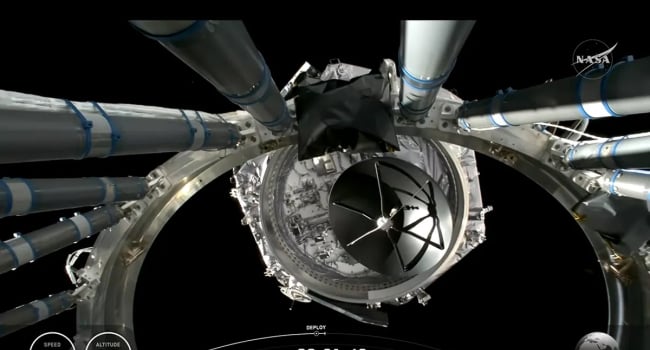
NASA successfully launches Nancy Grace Roman space telescope – "Hubble's successor"
At 15:26 Moscow time on 30 August, a SpaceX Falcon Heavy rocket lifted off from Launch Complex 39A at the Kennedy Space Center in Florida. On board was NASA's new space telescope, Nancy Grace Roman. The spacecraft successfully reached its designated trajectory and began independent flight. Scientists describe it as a major complement to the famous Hubble and the James Webb Space Telescope.
The Launch Sequence
The launch timeline proceeded strictly according to schedule. At the second minute of flight, the side boosters shut down their engines, separated from the core stage, and landed at the Cape Canaveral Space Force Station. Nearly four minutes after liftoff, the first stage completed its burn, and the second stage placed the observatory on its intended trajectory.
At 15:57 Moscow time, the telescope separated from the launch vehicle. Immediately afterwards, the spacecraft established communication via the satellite relay system and deployed its solar panels, which also serve as a thermal shield.
Where the Observatory Is Headed
Nancy Grace Roman is now heading toward the L2 Lagrange point—a stable gravitational zone approximately 1.6 million kilometres from Earth. The James Webb Space Telescope operates from the same location. Unlike Hubble, which orbits Earth, the new observatory will occupy a heliocentric orbit.
Scientific data transmission will be supported by NASA's Deep Space Network, as well as ground stations of the European and Japanese space agencies.
How Roman Differs from Hubble
The new telescope's primary mirror matches Hubble's in size. However, thanks to a different optical curvature and a larger camera, each image will cover roughly 100 times more sky area. This will allow the observatory to rapidly survey vast expanses of space.
Over its five-year mission, Roman is expected to map billions of galaxies. Scientists hope that its wide-field survey will help more efficiently detect supernovae and new exoplanets, as well as study the large-scale structure of the Universe.
In Brief
On 30 August, NASA successfully launched the Nancy Grace Roman telescope aboard a Falcon Heavy rocket. The spacecraft separated from the booster, deployed its solar panels, and is now heading toward the L2 Lagrange point. With a mirror the same size as Hubble's, its field of view is 100 times wider. Over five years of operation, the observatory is expected to map billions of galaxies and aid in the search for supernovae and exoplanets.
- Related News
- Would a nuclear explosion stop a city-killer asteroid?
- What would a person see if they fell into a black hole?
- A ninth planet may be hiding in the Solar System
- The Roman space telescope will reveal the Universe as Hubble and JWST cannot
- Scientists have learned to predict how muscles will adapt to lunar gravity
- 10,000 tiny probes to Saturn's rings and robots in lunar caves: NASA funds 18 visionary ideas
- Tech Jobs
- Most read
month
week
day
- Top tablets of August 2026: Experts name the best five 1384
- Top flagships of August 2026: Experts name the five best smartphones 1123
- From Excel to AI: A startup by specialists who relocated from Iran to Armenia helps businesses make sense of their data 1020
- The anniversary iPhone 20 will be as thin as the Air: what the insider revealed 793
- Why Bill Gates is no longer an AI optimist: Three major threats of AI 739
- 10,000 tiny probes to Saturn's rings and robots in lunar caves: NASA funds 18 visionary ideas 661
- 50,000 subscriptions and AI for schools: How Armenia plans to use artificial intelligence in education 648
- Robot knocks out teeth of five year old girl: Incident at Chinese museum leads to lengthy compensation dispute 639
- Apple prepares to raise iPhone prices following Samsung and Google 627
- 20 years without planet status: Will Pluto get its title back? 576
- Archive