


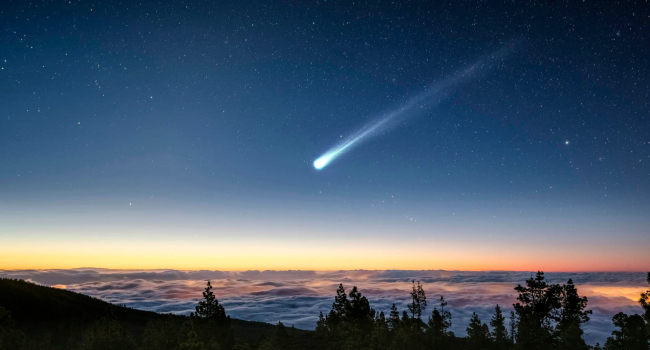
Two comets will be visible in Autumn 2026
This autumn, astronomy enthusiasts will be able to observe two comets—220P/McNaught and 161P/Hartley-IRAS—in the night sky. Observations will require fairly large amateur telescopes, according to Mikhail Maslov, lead engineer at the Vega Observatory of Novosibirsk State University.
Comet 220P/McNaught – in September
The first to become available will be comet 220P/McNaught. It will be observable throughout September. The object's brightness will gradually decrease from magnitude 10 to 12 over the course of the month. The best time for observation is the second half of the night. The comet will be located on the border between the constellations Taurus and Cetus.
Comet 161P/Hartley-IRAS – in October and November
The second comet, 161P/Hartley-IRAS, will appear in the sky in October and November. In appearance, it is typical of short-period comets: a green, spherical coma and a small, faint tail. Its brightness is expected to be around magnitude 10–11.
The best time to observe it is in the evening, before midnight. In October, the comet will pass through the constellations Aquarius, Equuleus, and Delphinus. In November, it will move into the constellations Aquila and Sagitta.
The orbital period of 161P/Hartley-IRAS around the Sun is 21 years. The comet was last observed in 2005.
In Brief
In autumn 2026, two comets will be visible through large amateur telescopes. 220P/McNaught will be available in September on the border of Taurus and Cetus, with a brightness of magnitude 10–12. 161P/Hartley-IRAS will appear in October–November with a brightness of magnitude 10–11 and will pass through the constellations Aquarius, Equuleus, Delphinus, Aquila, and Sagitta. Its orbital period is 21 years.
- Related News
- NASA successfully launches Nancy Grace Roman space telescope – "Hubble's successor"
- Would a nuclear explosion stop a city-killer asteroid?
- What would a person see if they fell into a black hole?
- A ninth planet may be hiding in the Solar System
- The Roman space telescope will reveal the Universe as Hubble and JWST cannot
- Scientists have learned to predict how muscles will adapt to lunar gravity
- Tech Jobs
- Most read
month
week
day
- Top tablets of August 2026: Experts name the best five 1424
- Top flagships of August 2026: Experts name the five best smartphones 1146
- From Excel to AI: A startup by specialists who relocated from Iran to Armenia helps businesses make sense of their data 1038
- The anniversary iPhone 20 will be as thin as the Air: what the insider revealed 804
- Why Bill Gates is no longer an AI optimist: Three major threats of AI 747
- 10,000 tiny probes to Saturn's rings and robots in lunar caves: NASA funds 18 visionary ideas 666
- 50,000 subscriptions and AI for schools: How Armenia plans to use artificial intelligence in education 664
- Robot knocks out teeth of five year old girl: Incident at Chinese museum leads to lengthy compensation dispute 647
- Apple prepares to raise iPhone prices following Samsung and Google 630
- 20 years without planet status: Will Pluto get its title back? 580
- Archive