


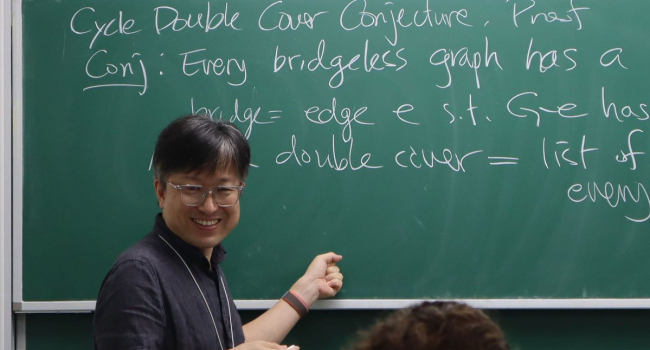
ChatGPT proves 50-year-old hypothesis from graph theory
OpenAI's GPT-5.6 Sol model has produced a proof of one of the classic unsolved problems in mathematics — the Cycle Double Cover Conjecture. The hypothesis had remained open for more than five decades.
What the hypothesis is
The Cycle Double Cover Conjecture was formulated in the 1970s. It states that a certain class of graphs (mathematical objects consisting of vertices and connecting edges) can be covered by a set of cycles such that each edge is included in exactly two closed loops.
Until now, mathematicians had only been able to prove this hypothesis for specific types of graphs. A general proof remained unattainable.
How the AI solved the problem
According to OpenAI, the GPT-5.6 Sol model developed a complete proof showing that any graph satisfying the hypothesis can be covered by a maximum of eight specially selected cycles.
To find the solution, the company used a special scenario: the problem was distributed among 64 AI agents working in parallel. The model was advised to continue searching even if the problem was considered unsolvable, and to allocate at least eight hours to the investigation.
Reaction from the scientific community
Mathematician Noga Alon from Princeton University noted that such results demonstrate the growing role of artificial intelligence in scientific research. According to him, AI is gradually becoming a valuable assistant in solving problems that previously required enormous effort from specialists.
Professor Andrew Sutherland from the Massachusetts Institute of Technology added that many mathematical problems are considered "extremely difficult" not because they are fundamentally unsolvable, but due to a lack of attention. Large language models are able to effectively combine existing methods and find new approaches.
In brief
OpenAI's GPT-5.6 Sol model has produced a proof of the Cycle Double Cover Conjecture — a mathematical problem that had remained open for over 50 years. This is the first complete proof showing that any graph of a certain class can be covered by a maximum of eight cycles. The discovery highlights the growing role of AI in solving complex scientific problems. The work was published in Scientific American.
- Related News
- What would a person see if they fell into a black hole?
- What happens when a supermassive black hole "switches off"
- "Dark photons" back in play: scientists revise constraints on dark matter
- Quantum entanglement has been achieved directly from sunlight for the first time
- Astronomers have found the fastest star in the Milky Way—it races around a black hole at 8% of the speed of light
- Rocky "mega Earth" found with 23 times the mass of our planet
- Tech Jobs
- Most read
month
week
day
- Top tablets of August 2026: Experts name the best five 954
- Top flagships of August 2026: Experts name the five best smartphones 861
- From Excel to AI: A startup by specialists who relocated from Iran to Armenia helps businesses make sense of their data 839
- The anniversary iPhone 20 will be as thin as the Air: what the insider revealed 707
- Why Bill Gates is no longer an AI optimist: Three major threats of AI 646
- Robot knocks out teeth of five year old girl: Incident at Chinese museum leads to lengthy compensation dispute 596
- How NASA's primary training centre is changing in the era of commercial space stations 591
- 10,000 tiny probes to Saturn's rings and robots in lunar caves: NASA funds 18 visionary ideas 582
- Apple prepares to raise iPhone prices following Samsung and Google 552
- 20 years without planet status: Will Pluto get its title back? 503
- Archive