


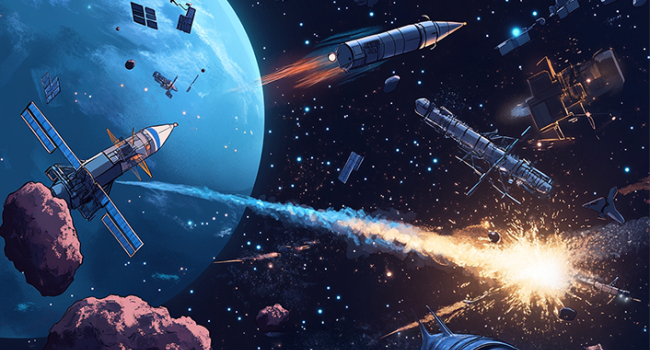
Why space games still can't convey the real scale of the Universe?
"The Universe is big. You just won't believe how vastly, hugely, mind-bogglingly big it is." These words from Douglas Adams' The Hitchhiker's Guide to the Galaxy perfectly describe the main problem of all space games. How can you convey the feeling of the infinite cosmos when even our Milky Way galaxy spans 100,000 light-years and contains hundreds of billions of stars?
A scale that's hard to imagine
As Space.com reports, astrophysicist Jeffrey Bennett, author of "The Scale of the Universe," illustrates the problem clearly. If the Solar System were scaled down by a factor of 10 billion, the Sun would become the size of a large grapefruit, Earth would be smaller than a ballpoint pen dot, and the distance to it would be about 15 meters. The Moon would be just 4 centimeters away. To reach the nearest stars, one would have to travel a distance comparable to the width of the United States.
This is precisely why developers are forced to find compromises. Fully realistic modeling of even a small part of the galaxy would instantly overwhelm any hardware.
How games solve the scale problem
Developers use several basic techniques:
- Levels of detail (LOD) — distant objects are simplified or replaced with simpler models
- Procedural generation — planets, systems, and entire sectors are created algorithmically "on the fly"
- Space compression — hyperspace jumps, warp drives, teleportation, and time acceleration
A prime example is the X series from the German studio Egosoft. Studio founder Bernd Lehahn explains that the main challenge is finding a balance between the feeling of vast space and engaging gameplay. On one hand, space should feel very large, otherwise players will feel cheated, but on the other, they don't want to force players to spend hours on empty flights.
In X4: Foundations, multi-tiered engines, jump gates, teleportation, and time acceleration are used. Additionally, during long flights, players are given minor tasks to avoid a feeling of emptiness.
Elite Dangerous approach
Frontier Developments went even further. Elite Dangerous features a 1:1 scale model of the Milky Way — approximately 400 billion star systems. The Stellar Forge technology, which relies on real astronomical data, is used to generate them.
Executive producer Gauthier Verquerre acknowledges that this is a huge challenge, noting that they must simultaneously show both the vast scale of space and the personal scale when the player is on the surface of a planet or inside a space station.
Why it's so difficult
Even with modern technology, fully conveying the feeling of cosmic infinity is practically impossible. Too much space — and the player will get bored. Too little — and the sense of the Universe's grandeur will be lost.
Developers continue to seek the perfect balance, understanding that space is not only about scale but also about the sense of wonder and exploration.
In brief
Space games face a fundamental problem: the Universe is incredibly vast, and technology still doesn't allow conveying its real scale without compromises. Developers use procedural generation, levels of detail, hyperjumps, and time acceleration to preserve the feeling of vast space while keeping the game engaging. The X series and Elite Dangerous are prime examples of different approaches to this eternal problem. Fully realistic space in games remains an unattainable dream for now.
- Related News
- DOOM gets its own dedicated handheld: Evercade will release just 3,000 units
- New games of August II: Mafia, Madden, aerial combat, and the Vietnam War
- How much RAM do you really need for gaming in 2026
- Meccha Chameleon։ Game created by two developers proves more profitable than top-tier projects
- Top mobile games in 2026: 10 worthy representatives of their genres
- Stories that touch your soul: Top PC games with the most powerful narratives
- Tech Jobs
- Most read
month
week
day
- Google now forces a 24-hour wait before APK installation: Android’s new defense against malware 715
- Firebird AI Joins UATE as a Strategic Member 644
- Earth’s microbes may survive on the Moon. Even a bootprint is enough to shield them 642
- Astronomers have found the fastest star in the Milky Way—it races around a black hole at 8% of the speed of light 625
- Quantum entanglement has been achieved directly from sunlight for the first time 610
- How NASA's primary training centre is changing in the era of commercial space stations 565
- The anniversary iPhone 20 will be as thin as the Air: what the insider revealed 549
- From Excel to AI: A startup by specialists who relocated from Iran to Armenia helps businesses make sense of their data 511
- Robot knocks out teeth of five year old girl: Incident at Chinese museum leads to lengthy compensation dispute 485
- Why Bill Gates is no longer an AI optimist: Three major threats of AI 461
- Archive