


Stories that touch your soul: Top PC games with the most powerful narratives
A good plot in video games has long ceased to be just an "excuse for gameplay." Today, games offer full-fledged dramas capable of inducing tears, rage, and deep empathy for characters made of pixels. They match, and sometimes even surpass, the best Hollywood movies and literary works.
Below is a selection of the most powerful narrative masterpieces on PC—ranging from time-tested classics to relatively recent releases. Each of them, in its own way, redefines what it means to "tell a story in a game."
The Open-World Icon: Red Dead Redemption 2
Rockstar created more than just a game; they forged an epic saga about the twilight of the Wild West. The story of Arthur Morgan and the Van der Linde gang is a tragedy about people trying to preserve their freedom and brotherhood in a world that no longer has room for them.
The game is astonishing not only for its massive open world but also for the incredible depth of its character writing. Arthur is one of the most lifelike and complex protagonists in gaming history. His personal arc, his relationships with gang members, and his gradual realization of the inevitability of change evoke a true emotional storm in the player. The attention to detail here is so immense that even random encounters in the prairies can spiral into compelling, miniature human dramas.
The Ultimate Interactive Movie: Detroit: Become Human
Quantic Dream mastered the "choices matter" concept to absolute perfection. The story of three androids who gradually awaken to consciousness and humanity raises poignant questions about the nature of the soul, discrimination, and free will.
The main strength of the game lies in its colossal branching paths. A single decision can drastically alter the fate of a character, and sometimes an entire city. There truly is no "right" path here—only consequences. Some players lose key characters in the first third of the game, while others guide everyone to a happy (or not-so-happy) finale. It is a genuine engine for generating powerful, highly personal stories.
The Dark Fantasy Benchmark: The Witcher 3: Wild Hunt (inc. DLCs)
Even years after its release, The Witcher 3 remains the pinnacle of its genre. The search for Ciri and the confrontation with the Wild Hunt form just the basic framework. The game's true treasure lies in its side quests, which frequently turn out to be deeper and more moving than the main narrative.
Take the Bloody Baron's storyline, for instance—it is a masterclass in giving a secondary character a tragedy of Shakespearean proportions. Furthermore, the expansions Hearts of Stone and especially Blood and Wine easily rival standalone AAA titles in terms of narrative density and quality.
Unrivaled Role-Playing Freedom: Baldur’s Gate 3
Larian Studios achieved the near-impossible: capturing the authentic spirit of tabletop D&D and translating it into a digital format without losing its essence. The plot begins with a parasite inside your hero's head and culminates in deciding the fate of the entire Sword Coast.
Yet, the highlight isn't the main plot itself, but how fluidly the world reacts to the player. Want to romance a dragon? Go right ahead. Decide to betray all your allies and side with the Absolute? The game will allow it. The chemistry between companions, their personal arcs, and their reactions to your wildest choices make every single playthrough entirely unique.
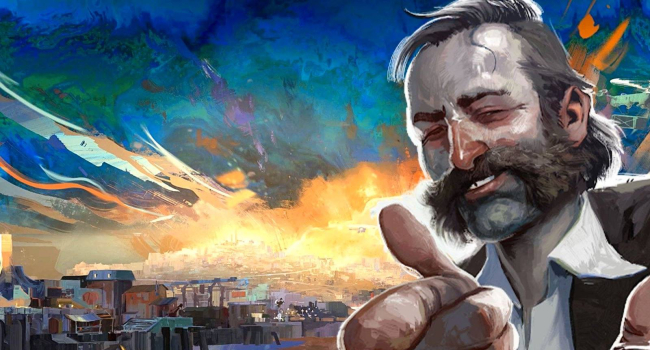
A Literary Masterpiece: Disco Elysium
There is no traditional combat system here; the entire game is built on dialogue and internal monologues. You play as a washed-up, alcoholic cop who wakes up in a trashed hostel room after a monumental bender. Remembering absolutely nothing (not even his own name), he must investigate a brutal murder.
Your main adversary—and simultaneously your most fascinating conversationalist—is your own mind, fractured into 24 distinct personality traits. Each has its own voice, temperament, and ideology, ranging from a cynical pragmatist to an idealistic communist or an advocate for self-destruction.
Disco Elysium is not just a game; it is a profound literary experience. It offers a deep psychological portrait, sharp political satire, and a top-tier detective story all in one package. Many rightfully consider it one of the greatest text-driven games ever made.
- Related News
- DOOM gets its own dedicated handheld: Evercade will release just 3,000 units
- New games of August II: Mafia, Madden, aerial combat, and the Vietnam War
- How much RAM do you really need for gaming in 2026
- Meccha Chameleon։ Game created by two developers proves more profitable than top-tier projects
- Why space games still can't convey the real scale of the Universe?
- Top mobile games in 2026: 10 worthy representatives of their genres
- Tech Jobs
- Most read
month
week
day
- Top tablets of August 2026: Experts name the best five 1329
- Top flagships of August 2026: Experts name the five best smartphones 1084
- From Excel to AI: A startup by specialists who relocated from Iran to Armenia helps businesses make sense of their data 983
- The anniversary iPhone 20 will be as thin as the Air: what the insider revealed 778
- Why Bill Gates is no longer an AI optimist: Three major threats of AI 724
- 10,000 tiny probes to Saturn's rings and robots in lunar caves: NASA funds 18 visionary ideas 645
- Robot knocks out teeth of five year old girl: Incident at Chinese museum leads to lengthy compensation dispute 626
- 50,000 subscriptions and AI for schools: How Armenia plans to use artificial intelligence in education 625
- Apple prepares to raise iPhone prices following Samsung and Google 616
- How NASA's primary training centre is changing in the era of commercial space stations 606
- Archive