


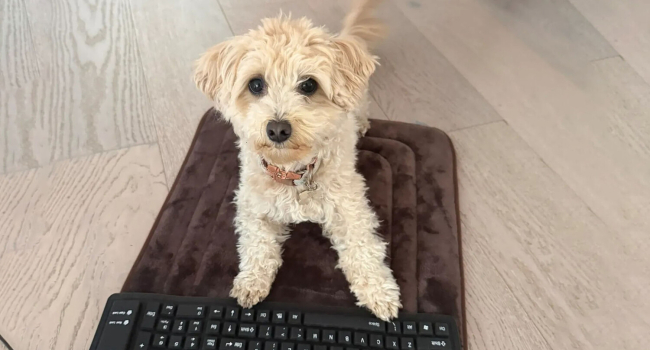
Engineer taught his dog to program and create games using AI
Former Oculus engineer Caleb Leake conducted an unusual experiment: he set up a system in which his dog, Momo, literally “programmed” games. Of course, the dog did not learn Python or C++ — she simply pressed keys with her paw, and then a generative AI took over. The results turned out to be surprisingly functional, and Leake подробно described the entire process on his blog and demonstrated it on YouTube.
How It Worked
Caleb used the chatbot Claude and configured it so that the neural network would interpret any random string of characters as “brilliant instructions from a mysterious game designer.” Momo was trained to press keys on a modified keyboard: for each press, she received a treat from an automatic feeder. The resulting meaningless sequences were sent to Claude, which interpreted them as a request to create a game.
Additionally, the AI acted as an automated tester: after generating the code, it launched the game itself and checked whether it worked. If the project turned out to be unplayable, Claude received a “redo” command and generated a new version.
All system control was handled through a single-board computer, Raspberry Pi, which connected the keyboard, the feeder, and Claude.
Minimum Requirements and Early Results
At first, the games were extremely unstable — mostly chaotic collections of objects without any logic. Leake then introduced strict criteria: the game had to include controls, sound, a playable character, and at least one enemy. After that, the system began producing fully playable projects — simple, but functional.
A video demonstrating the process and links to the resulting mini-games were published on Caleb’s blog and on YouTube.
Why He Did It
The experiment is part of a broader exploration of “vibe coding,” where a developer gives AI not strict instructions but only a general mood or random prompts, and the neural network fills in the details. Leake wanted to show how far generative models have progressed: even completely random input from a dog can be turned into a playable prototype.
It is also a humorous way to demonstrate how the barrier to entry in programming has dropped so dramatically that it is now accessible to virtually anyone — even an animal with a paw and a treat.
In Brief
Former Oculus engineer Caleb Leake built a system in which his dog Momo pressed keys with her paw, and the generative AI Claude turned random symbols into the code for simple games. After introducing minimum requirements (controls, sound, character, enemy), the system produced genuinely playable projects. Everything ran on a Raspberry Pi with an automatic feeder to motivate the dog. The experiment highlights the potential of “vibe coding” and shows how AI can now work even with completely random input. Videos and games are available on the author’s blog and on YouTube.
- Related News
- Beijing opens "Kindergarten" for robots: Machines learn from their own mistakes
- Anthropic teaches AI to control real-world machines
- DeepSeek or ChatGPT: Which is better in 2026?
- What Claude can do: A complete overview of one of the most popular AI assistants
- 50,000 subscriptions and AI for schools: How Armenia plans to use artificial intelligence in education
- How to work with neural networks properly: 5 rules that actually help
- Tech Jobs
- Most read
month
week
day
- Two comets will be visible in Autumn 2026 1252
- DeepSeek or ChatGPT: Which is better in 2026? 1026
- NASA successfully launches Nancy Grace Roman space telescope – "Hubble's successor" 666
- Anthropic teaches AI to control real-world machines 650
- New Apple CEO to refresh top management team: What we know 634
- Scientists have learned to transmit data by laser through atmospheric disturbances 620
- Cosmonaut Harutyun Kiviryan passes pre-flight exam on ISS simulator 620
- Beijing opens "Kindergarten" for robots: Machines learn from their own mistakes 600
- What will happen to the human body on Mars? 585
- Dark matter detector captures the weakest neutrinos ever detected 544
- Archive