


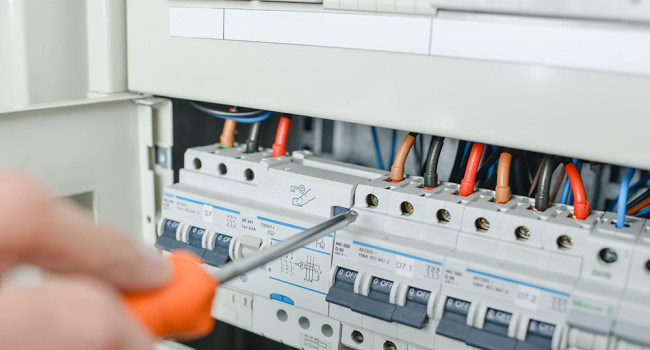
Circuit breakers: What you need to know
Circuit breakers (CBs) are essential devices that protect electrical circuits from overloads and short circuits. Choosing the right breaker with the correct specifications ensures the safe operation of wiring and connected equipment. The main parameter is the tripping characteristic, which determines how quickly the device reacts. Here’s a detailed look at key features and types of circuit breakers.
What Is a Circuit Breaker?
A circuit breaker is a switching device designed to protect an electrical circuit from overloads and short circuits. When a fault occurs, the CB interrupts the current, preventing damage to wiring, appliances, and fire hazards. The reaction speed depends on the current and other factors, known as tripping parameters.
Types of Trippers
Circuit breakers use two main types of trippers for protection:
- Electromagnetic Trip: Instantly opens the contacts when a short-circuit current occurs. High currents generate a magnetic field that moves a core, breaking the circuit. Any arc formed is extinguished in a special arc-quenching chamber, preventing contact or casing damage.
- Thermal Trip: Uses a bimetallic strip that bends when heated by overload, opening the contact. Reaction time can range from seconds to minutes or even hours, depending on current and device specifications. Thermal trips can misfire in hot environments.
Key Specifications of Circuit Breakers
- Rated Current (In)
The maximum current a CB can carry continuously without tripping. Exceeding this triggers the breaker. Common household ratings: 6, 10, 16, 20, 25, 32, 40, 50, 63 A. Some models go up to 80–100 A. The rated current is marked on the breaker body. - Time-Current Characteristic (TCC)
Shows how the breaker’s trip time depends on current. Breakers are classified as:
- A: Trips at 2–3× rated current; very sensitive, can trip at 30% overload.
- B: Trips at 3–5× rated current; suitable for older wiring.
- C: Trips at 5–10× rated current; most common for modern household circuits with high inrush currents.
- D: Trips at 10–20× rated current; for circuits with high surge currents.
- K: AC: 12×, DC: 18×; used in specialized networks.
- Z: AC: 3×, DC: 4.5×; very sensitive applications.
- Poles
Determines how many independent contacts protect the network:
- 1P (single-pole): Protects one phase in single-phase networks; most common for homes.
- 2P (double-pole): Opens phase and neutral simultaneously; safer for single-phase systems.
- 3P (three-pole): Protects three-phase networks.
- 4P (four-pole): Disconnects three phases and neutral together in three-phase systems.
- Maximum Breaking Capacity
The highest short-circuit current the breaker can safely interrupt. Typical modular CBs handle 4.5–6 kA. - Current-Limiting Class
Indicates how quickly the breaker reacts to a short circuit. Most CBs are class 3, tripping in ≤6 ms, preventing wiring and equipment damage. - Rated Voltage
Most CBs are designed for single-phase (220–230 V) or three-phase (380–400 V) networks. Some, like the VA57 series, support up to 690 V AC for specialized uses.
Other Considerations
- Connection type: rear, front, or universal.
- Selectivity: selective (delayed 1 s) or non-selective (instant 0.02–0.1 s).
- Actuation: manual or motor-driven.
- Construction: modular (0.5–125 A), molded-case (10–2500 A), or air-break (800–6300 A).
Why It Matters
Choosing the right circuit breaker ensures network safety. The wrong CB may trip unnecessarily or fail to protect wiring during a fault, risking equipment damage or fire. For modern household circuits, type C with 16–25 A is common, while type B is better for older wiring.
In Short
Circuit breakers are crucial for protecting circuits from overloads and short circuits. Key specs — rated current, time-current characteristic, poles, and breaking capacity — determine their effectiveness. Electromagnetic and thermal trippers provide fast or gradual response depending on conditions. Understanding these parameters lets you select the right CB, ensuring safety and reliability of your electrical system.
- Related News
- How to choose a TV and not overpay for features you'll never use
- 4 key differences between modern washing machines and models from 5–10 years ago
- Why do modern TVs break faster than older ones?
- Direct sunlight can damage your TV: Why does this happen?
- Five gadgets that could change how we work in the kitchen
- A dream for office workers: Lenovo introduces the Yoga Silent Mouse — the quietest mouse on the market
- Tech Jobs
- Most read
month
week
day
- From Excel to AI: A startup by specialists who relocated from Iran to Armenia helps businesses make sense of their data 633
- The anniversary iPhone 20 will be as thin as the Air: what the insider revealed 615
- How NASA's primary training centre is changing in the era of commercial space stations 574
- Top flagships of August 2026: Experts name the five best smartphones 559
- Why Bill Gates is no longer an AI optimist: Three major threats of AI 546
- Robot knocks out teeth of five year old girl: Incident at Chinese museum leads to lengthy compensation dispute 541
- 10,000 tiny probes to Saturn's rings and robots in lunar caves: NASA funds 18 visionary ideas 484
- How to make your new smartphone more secure: expert tips 475
- Apple prepares to raise iPhone prices following Samsung and Google 464
- "Dark photons" back in play: scientists revise constraints on dark matter 460
- Archive