


How many pascals a robot vacuum actually needs: Understanding suction power
Manufacturers often boast about figures like 8000, 10 000, or even 15 000 Pa, and buyers frequently assume that bigger numbers mean better cleaning. In reality, such values are almost never used in day-to-day cleaning and are needed only in rare situations. Here is where marketing ends and real efficiency begins.
Why the Advertised 15 000 Pa Is Almost Always Marketing
Most robot vacuums operate by default in Eco or Standard mode, where real suction power is only 30–50 percent of the maximum. Peak values are activated only briefly and only under certain conditions. If your home has nothing but hard floors—laminate, parquet, or tile—a 15 000 Pa robot will clean exactly the same as a 5000 Pa model, but will be louder and drain its battery faster.
When High Power Is Actually Needed
There are only three scenarios in which the robot engages the motor at full strength:
- High-pile carpets. This is where strong suction is needed to pull dust from deep within the fibers. Modern models automatically detect carpets (via optical and ultrasonic sensors) and activate maximum mode—this is the so-called carpet boost.
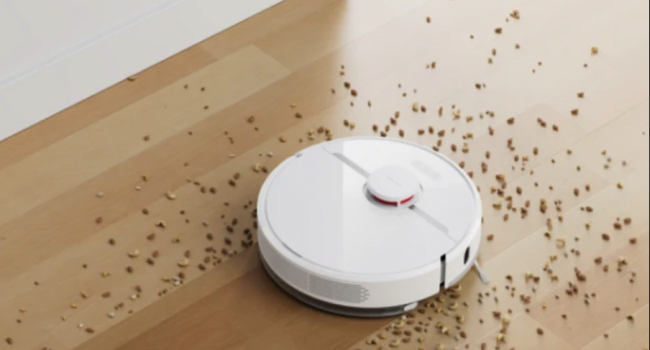
- Heavy localized dirt. Mid-range and premium models can recognize the degree of contamination and temporarily increase power if, for example, they enter an area with spilled sand or dirt brought in on shoes.
- Manual settings for problem zones. The app allows users to set higher power for specific rooms or areas, such as hallways, entryways, or around a pet’s bowls.
How Many Pascals Are Enough for Different Surfaces
For homes with hard floors (laminate, parquet, tile, linoleum), the optimal peak range is 4000–6000 Pa. This is more than enough for daily cleaning of dust, pet hair, crumbs, and small debris. The difference between 5000 and 15 000 Pa will be noticeable only in laboratory tests—not on your actual floor.
For homes with carpets, the situation changes: if pile height exceeds 10–12 mm, or if you have pets that shed heavily, you should look at models from 8000–10 000 Pa and above—but only if the automatic carpet boost feature works effectively.
What to Look at Instead of Just the Numbers
The following factors matter far more than peak suction figures:
- The presence of automatic power increase on carpets (carpet boost, auto boost, intelligent power control).
• Suction levels in Standard and Quiet modes, since these are used 90 percent of the time.
• The quality of the main brush: rubber rollers or combined turbo brushes pick up debris better than simple bristle brushes.
• The airtightness of the airflow system and the quality of the HEPA filter—without these, even a powerful motor will blow fine dust back into the room.
In Brief
For a home with hard floors, a robot vacuum with peak power of 4000–6000 Pa and good automatic power adjustment is sufficient. Values above 10 000 Pa are justified only with thick carpets or heavy pet-related dirt. The key is not the biggest number in the advertisement but the device’s ability to distribute power intelligently and the quality of its brushes and filters. Paying extra for “excess” pascals that almost never activate simply makes no sense.
- Related News
- How to choose a TV and not overpay for features you'll never use
- 4 key differences between modern washing machines and models from 5–10 years ago
- Why do modern TVs break faster than older ones?
- Direct sunlight can damage your TV: Why does this happen?
- Five gadgets that could change how we work in the kitchen
- A dream for office workers: Lenovo introduces the Yoga Silent Mouse — the quietest mouse on the market
- Tech Jobs
- Most read
month
week
day
- From Excel to AI: A startup by specialists who relocated from Iran to Armenia helps businesses make sense of their data 633
- The anniversary iPhone 20 will be as thin as the Air: what the insider revealed 615
- How NASA's primary training centre is changing in the era of commercial space stations 574
- Top flagships of August 2026: Experts name the five best smartphones 559
- Why Bill Gates is no longer an AI optimist: Three major threats of AI 546
- Robot knocks out teeth of five year old girl: Incident at Chinese museum leads to lengthy compensation dispute 541
- 10,000 tiny probes to Saturn's rings and robots in lunar caves: NASA funds 18 visionary ideas 484
- How to make your new smartphone more secure: expert tips 475
- Apple prepares to raise iPhone prices following Samsung and Google 464
- "Dark photons" back in play: scientists revise constraints on dark matter 460
- Archive