


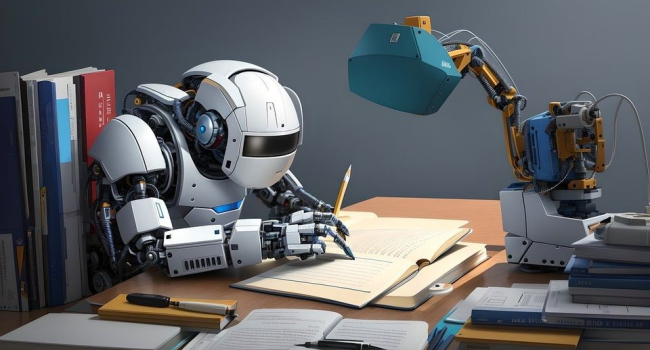
Education in the post-GPT era: Free will as humanity’s last superpower
Artificial intelligence will replace administrative tasks, but humans possess a unique superpower that machines will never be able to replicate. This idea was shared by Vaagn Poghosyan, founder of Instigate Venture Studio, during his speech at DigiConf 2025.
As co-founder of the RealSchool Foundation, Poghosyan presented his vision of education for the “post-GPT era,” a world where machines can create better than humans — yet cannot make game-changing decisions. “A computer may even be more creative than a human, but the existence of free will remains beyond the reach of modern science. Free will is our unique currency, something machines will never be able to reproduce,” he said, grounding his argument in thermodynamics and statistical physics.
He noted that AI is absorbing routine functions: “Imagine an insurance agent who, following a strict policy, denies coverage for an appendicitis case — that’s the kind of task apps will replace. But what if an elderly woman begs for an exception? That requires understanding context and consciously breaking the rule — an act of free will that only a human can perform.”
An Expert with AI Will Replace 50 Juniors. How to Survive?
Poghosyan also cited alarming statistics. According to one of his colleagues — the founder of a robotics company — AI amplifies the productivity of experts tenfold, but boosts junior specialists only by about 10%. “One expert with AI will replace 50 juniors. A junior with AI will do the work of two. So how can a newcomer enter the profession?”
His answer: only through deep education and preparation for “acts of sovereignty” — the creation of new rules instead of submission to old ones. “Study the theory of emergencies, free will, sovereignty. This is the Real School doctrine for the post-AI era.”
Education, he stressed, should not be about training people to work with machines, but about strengthening what makes us human. “Only by preserving free will will we remain competitive in the post-GPT world.”
Time to Break Boundaries
“Our goal is education for the life of the future — a life where this power belongs only to humans,” Poghosyan stated.
He criticized the long-standing educational model that separates ‘real schools’ (engineering) from ‘classic schools’ (arts and theology). “Should we continue dividing students into humanitarians and tech specialists? Can physicists without theology, or humanitarians without physics, truly create policy?” His answer: integration.
The Instigate Academy is developing a curriculum where engineering and classical sciences reunite. “We are returning to the maternal philosophy, where knowledge is not about classification, but about synthesis,” he emphasized.
Poghosyan believes that once AI frees parents from routine work, they will once again be able to educate their children themselves. “Today’s schools, created for commoners three centuries ago, do not prepare professionals for the post-AI world. Once parents regain their freedom, they must teach their children both the natural and classical sciences.”
- Related News
- 50,000 subscriptions and AI for schools: How Armenia plans to use artificial intelligence in education
- How to work with neural networks properly: 5 rules that actually help
- Why Bill Gates is no longer an AI optimist: Three major threats of AI
- Firebird AI Joins UATE as a Strategic Member
- Neural networks can't read minds: 4 key rules for working effectively with AI
- OpenAI prepares to go public in 2027
- Tech Jobs
- Most read
month
week
day
- Top tablets of August 2026: Experts name the best five 893
- Top flagships of August 2026: Experts name the five best smartphones 843
- From Excel to AI: A startup by specialists who relocated from Iran to Armenia helps businesses make sense of their data 830
- The anniversary iPhone 20 will be as thin as the Air: what the insider revealed 701
- Why Bill Gates is no longer an AI optimist: Three major threats of AI 638
- Robot knocks out teeth of five year old girl: Incident at Chinese museum leads to lengthy compensation dispute 594
- How NASA's primary training centre is changing in the era of commercial space stations 590
- 10,000 tiny probes to Saturn's rings and robots in lunar caves: NASA funds 18 visionary ideas 575
- Apple prepares to raise iPhone prices following Samsung and Google 546
- How to make your new smartphone more secure: expert tips 498
- Archive