


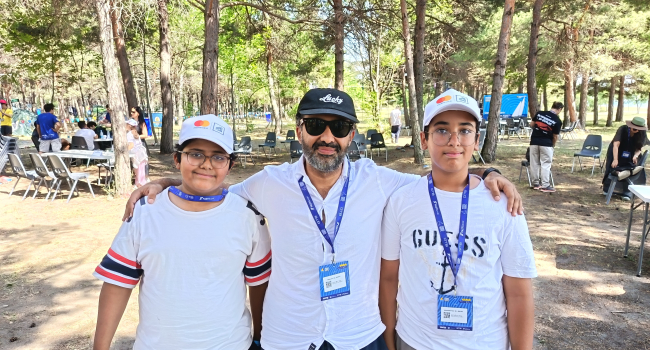
Armenians have much to offer the world: A Qatari investor on choosing startups and Armenia's potential
For an investor, working with early‑stage startups always involves high uncertainty. A company may have a promising technology and an interesting idea, but it does not yet have stable revenue, a large customer base, or a proven business model. Moreover, a significant proportion of startups ultimately fail. So the key question for an investor is how, among a large number of young companies, to find the one that truly has the potential to grow into a successful business.
Abdulla Mohammed Al‑Naimi, Managing Director of Doha Business Consulting and a specialist in investment, venture capital, and asset management, who is currently in Armenia, spoke to News.am Tech about what to look for when selecting startups and why a project's failure does not necessarily mean a loss for the investor.
First and foremost — the founders
According to Al‑Naimi, when making an investment decision, he looks first at the people behind the project. "The simplest way is to see whether you like the co‑founders. If you don't like the co‑founder, don't invest in the company," he says.
The reason is that at an early stage, the investor is effectively investing not so much in an existing product as in the team's ability to build and grow a business. The idea may change, the initial product may fail, and the company may pivot to a different business model. What matters far more is how the founders work, make decisions, and handle difficulties.
Al‑Naimi notes that with a modest initial investment, a certain level of risk is acceptable, giving entrepreneurs a chance to prove themselves. But first and foremost, the investor needs to determine whether these people can be trusted.
The investor gives the startup a specific task
To test entrepreneurs in practice, Al‑Naimi uses his own method. He gives the team a concrete task and watches what they can achieve in a few days.
The task may vary. For example, the investor may ask the startup to acquire a customer, arrange a phone call with a potential partner, or secure funding from one of the investment funds he works with. Sometimes the task is simpler—to prepare a better pitch deck.
The point, according to Al‑Naimi, is not to see how well the entrepreneur can talk about their project, but whether they can actually deliver. If a person receives a concrete task and returns a few days later with a result, that gives the investor additional insight into their ability to work, achieve goals, and keep promises.
Therefore, Al‑Naimi believes that a combination of two things—assessing the founders and testing them in practice—is already enough to make a decision on an initial investment.
What to do if most startups fail
The high failure rate among startups is one of the main challenges of venture investing. Even if an investor carefully selects projects, the success of any single company cannot be guaranteed. Al‑Naimi agrees, but believes that the investor should evaluate not the individual bet but the entire investment portfolio.
In his view, if you invest in several companies operating in the same sector, the failure of one does not necessarily become a disaster. The success of another company can offset the losses. This is why he considers it important to make multiple investments in the same area and to stick to a chosen strategy.
"Even if you fail with one company, another might succeed," the investor explains. During the conversation, he also noted that statistics sometimes look extremely pessimistic—even suggesting that 99% of startups fail. However, in his view, even under such a scenario, a portfolio strategy allows the investor to count on at least one project becoming extraordinarily successful.
At the same time, the problem may not lie only with the startups themselves. In Al‑Naimi's opinion, investment funds can also make a mistake when they start changing their strategy.
If a fund initially chose a specific sector, investment horizon, and approach to selecting companies, and then begins to constantly change direction, that can reduce the effectiveness of the entire strategy. Al‑Naimi believes that an investor should consistently stick to their investment hypothesis.
He draws an analogy with a person who has a certain amount of money and regularly makes small bets. What matters is not any single bet, but the system of risk distribution itself. Of course, such a strategy does not exclude the possibility of a major systemic crisis.
Which technologies the investor is betting on
Doha Business Consulting, which Al‑Naimi manages, focuses primarily on three areas: artificial intelligence, quantum computing, and blockchain.
At the same time, his investment portfolio is not limited to the technology sector. According to him, there are projects in East Africa, particularly sustainable tourism complexes, as well as investments in e‑commerce platforms in Qatar.
This approach allows him to combine an interest in promising technologies with investments in more traditional sectors.
Why Armenia is interesting
Most of the companies Al‑Naimi encounters in Armenia are currently at too early a stage for him to invest directly. Nevertheless, he considers such work useful for himself.
He says that engaging with young companies allows him to see new technologies before they become widespread. It also gives him the opportunity to observe how entrepreneurs frame problems, what solutions they propose, and how their thinking evolves. This is why participating in the entrepreneurial environment is not only about finding direct investment opportunities for him.
In addition, Al‑Naimi uses his trip to Armenia as an educational experience for his two sons. He travels with them and shows them how his work operates. The investor says he wants his children to see entrepreneurship not only as a ready‑made business but as a process—from the initial idea to the subsequent stages of a company's development.
Armenians have much to offer the world
Al‑Naimi sees great potential in Armenia and its entrepreneurial ecosystem. He said that as a child, he perceived Armenians more as a distinct nation rather than as residents of a specific country. Later, he visited Armenia and, in his words, fell in love with the country.
Since then, he noted, much has changed. He particularly highlights the younger generation and the Armenian diaspora, whose members have great ambitions and are already achieving their goals.
"You have a lot to give the world," Al‑Naimi said. He also described Armenians as one of the most resilient nations he has worked with, and expressed optimism about the country's future.
In his view, noticeable changes are taking place in Armenia today, and the entrepreneurial environment is gaining new opportunities for growth.
"I see you moving forward and becoming bigger," the investor remarked, adding that Armenia is among the countries where a simple walk through the streets can make a person feel happy.
- Related News
- From Excel to AI: A startup by specialists who relocated from Iran to Armenia helps businesses make sense of their data
- Four minutes that can change a startup's fate: How to prepare a pitch that actually gets heard?
- Campio startup: A unified platform for searching, booking, and paying for hiking trips
- Why startup–corporate collaboration often turns out to be a trap: Interview with Helmut Kranzmaier
- A good idea isn't enough: What qualities does a successful startup founder need?
- 'No one should destroy someone else's dream': Steve Mackie on why you should never tell founders their idea has no future
- Tech Jobs
- Most read
month
week
day
- Top tablets of August 2026: Experts name the best five 1783
- Two comets will be visible in Autumn 2026 948
- Samsung unveils monitor with record-breaking 1100 Hz refresh rate 772
- DeepSeek or ChatGPT: Which is better in 2026? 652
- How to work with neural networks properly: 5 rules that actually help 636
- NASA successfully launches Nancy Grace Roman space telescope – "Hubble's successor" 607
- Anthropic teaches AI to control real-world machines 597
- New Apple CEO to refresh top management team: What we know 591
- Blue light from screens: Is it really dangerous for eyes, and what should you know? 471
- Scientists have learned to transmit data by laser through atmospheric disturbances 452
- Archive