


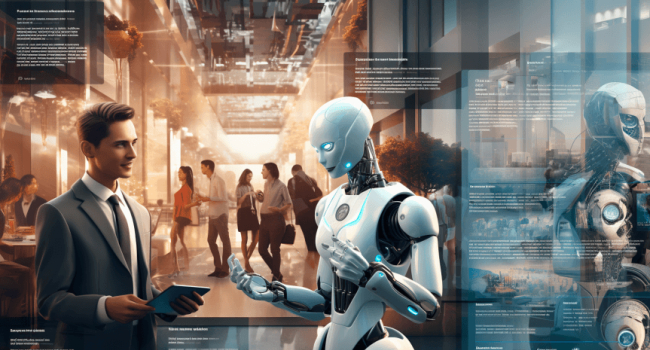
Artificial intelligence and tour guides: What risks the profession faces and how to prepare
Artificial intelligence is having a major impact on the labor market and is rapidly reshaping it — and the field of tour guiding is no exception. Even today, free and low-cost apps offer tourists ready-made texts, routes, and historical background. At first glance, this seems like a convenient and fast alternative to a live guide. However, behind this technological simplicity lie serious risks for the profession, according to Yasha Solomonyan, President of the Armenian Association of Professional Tour Guides.
A Cheap Alternative or a Threat to Quality?
There are now many applications that allow users to access AI-generated information for free. For tourists, this is quick and often free or very inexpensive. That is precisely why AI is increasingly being seen as an alternative to a human tour guide.
However, as Yasha Solomonyan noted in an interview with NEWS.am Tech, this approach has clear limitations. First of all, information provided by AI is not always accurate. In addition, artificial intelligence cannot replicate the dynamism, emotional engagement, and human interaction that a professional guide brings. A tour is not just about facts — it is about live communication, the ability to sense the audience, respond to questions, and adapt the material accordingly.
That said, the issue is not only about quality. More serious challenges may lie ahead: the world is rapidly moving toward more advanced forms of artificial intelligence. If AI begins to convincingly imitate human emotions and behavior, this could become a serious problem for many industries, including tourism and tour guiding.
Will AI Replace Humans?
According to representatives of the professional community, artificial intelligence itself will not replace humans. However, people who use AI may replace those who do not, Solomonyan believes.
“AI is a tool, like a smartphone. It should neither be overestimated nor underestimated. A modern professional must master AI tools and deepen their knowledge in order to apply them effectively in their work,” he said.
In his view, using AI can make a tour guide’s work more efficient: it can speed up and automate processes, simplify tasks, and free up time for professional and personal development.
Thus, the real issue is not a confrontation between technology and humans, but rather how professionals adapt to new conditions, Solomonyan argues.
Competition and the Role of the State
There is also an economic dimension. Many tourists are unwilling to spend money on a tour guide and prefer to use an app instead. In this situation, the state could play a key role.
“If not today, then in the future, legislative regulation aimed at protecting workers’ interests will be necessary. Without appropriate measures, artificial intelligence could quickly push thousands of specialists out of the labor market,” Solomonyan said.
According to him, there have already been similar precedents. In the past, tourists would come to Armenia with their own foreign guides. As a result, legal requirements were introduced mandating that tour guides obtain certification, speak Armenian, and comply with established standards. These measures created filters and helped protect the interests of local professionals.
Similar mechanisms could be applied to the use of AI. Today, numerous applications operate within the country without paying taxes locally. For example, an app may be sold for one dollar without paying a single unit of tax in Armenia, while a local tour guide working there pays taxes in full. Online platforms can and should be brought into the country’s legal and tax framework, Solomonyan believes.
Industry representatives emphasize that their task is not to draft specific legislative initiatives, but to draw the attention of relevant authorities to potential future challenges so that the government can introduce necessary changes in a timely manner.
AI Risks as a Key Topic of Professional Discussion
The risks and opportunities associated with artificial intelligence became the central topic of discussion at an event organized by the Armenian Association of Professional Tour Guides on the occasion of International Tourist Guide Day, which is celebrated annually on February 21.
On this day, the association traditionally holds a large-scale event bringing together hundreds of industry professionals. This year, one of the most pressing topics — “Artificial Intelligence and Tour Guiding” — was selected. During a two-hour panel discussion featuring invited speakers, participants explored potential risks, the need for adaptation, and possible regulatory approaches.
- Related News
- Beijing opens "Kindergarten" for robots: Machines learn from their own mistakes
- Anthropic teaches AI to control real-world machines
- DeepSeek or ChatGPT: Which is better in 2026?
- 50,000 subscriptions and AI for schools: How Armenia plans to use artificial intelligence in education
- How to work with neural networks properly: 5 rules that actually help
- Why Bill Gates is no longer an AI optimist: Three major threats of AI
- Tech Jobs
- Most read
month
week
day
- Top tablets of August 2026: Experts name the best five 1731
- Top flagships of August 2026: Experts name the five best smartphones 1602
- 50,000 subscriptions and AI for schools: How Armenia plans to use artificial intelligence in education 876
- Two comets will be visible in Autumn 2026 742
- Samsung unveils monitor with record-breaking 1100 Hz refresh rate 735
- Foldable iPhone appeals to almost no one: Three-quarters of Americans don't want one 622
- A simple way to spend less time on your phone: Choosing your own goals? 609
- Would a nuclear explosion stop a city-killer asteroid? 603
- How to work with neural networks properly: 5 rules that actually help 591
- New Apple CEO to refresh top management team: What we know 537
- Archive