


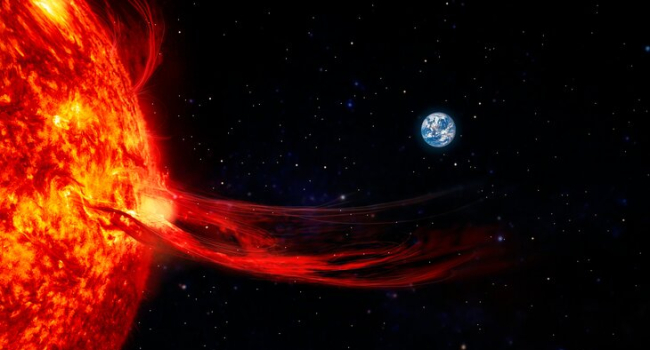
An X8.11-class solar flare erupts on the Sun — the third of 2026
The Laboratory of Solar Astronomy at the Space Research Institute of the Russian Academy of Sciences has recorded an extremely powerful X8.11-class solar flare. This is already the third event of maximum intensity since the beginning of the year, according to a statement published on the laboratory’s Telegram channel.
What is known about the flare
The flare occurred in an active region on the visible side of the Sun. Its intensity reached X8.11, one of the highest levels observed in recent years. At present, Earth is not in the zone of a direct impact from a coronal mass ejection.
“An X8.11-level flare has occurred on the Sun. Earth is not yet in the zone of direct impact,” the laboratory said in its statement.
The previous two highest-class X flares were recorded on February 1 and January 18, 2026. All three events took place during a period of heightened activity in the current solar cycle.
Possible consequences for Earth
Strong X-class flares are often accompanied by coronal mass ejections that can reach Earth within one to three days and trigger geomagnetic storms. Such storms may lead to:
- disruptions of shortwave radio communications, especially at high latitudes;
- malfunctions in satellite systems and radio-based navigation;
- voltage fluctuations in power grids and industrial networks.
During particularly powerful events, the geographic range of auroras expands, making them visible even at mid-latitudes, including southern Russia and parts of Europe.
There is still no definitive scientific consensus on how geomagnetic storms affect human health. Weather-sensitive individuals may experience headaches, blood pressure fluctuations, or sleep disturbances, but this applies only to a portion of the population.
What happens next
Scientists are continuing to monitor the evolution of the active region and the possibility of a coronal mass ejection. If it is directed toward Earth, a geomagnetic storm could begin in the coming days. Forecasts will be refined as new data becomes available.
In brief
An X8.11-class solar flare, the third of maximum intensity since the start of 2026, has occurred on the Sun. Earth is currently outside the zone of direct impact, but the situation may change in the coming days. Disruptions to communications, navigation systems, and power grids are possible, along with an expansion of the auroral zone. The impact on human health remains a subject of debate, but such events always pose risks to technology and satellites. Space weather forecasts are being closely monitored.
- Related News
- What will happen to the human body on Mars?
- Dark matter detector captures the weakest neutrinos ever detected
- NASA successfully launches Nancy Grace Roman space telescope – "Hubble's successor"
- Antarctic microbes survived in open space
- Two comets will be visible in Autumn 2026
- Would a nuclear explosion stop a city-killer asteroid?
- Tech Jobs
- Most read
month
week
day
- Top tablets of August 2026: Experts name the best five 1647
- Top flagships of August 2026: Experts name the five best smartphones 1453
- From Excel to AI: A startup by specialists who relocated from Iran to Armenia helps businesses make sense of their data 1171
- The anniversary iPhone 20 will be as thin as the Air: what the insider revealed 854
- Why Bill Gates is no longer an AI optimist: Three major threats of AI 824
- 50,000 subscriptions and AI for schools: How Armenia plans to use artificial intelligence in education 822
- The Roman space telescope will reveal the Universe as Hubble and JWST cannot 672
- Samsung unveils monitor with record-breaking 1100 Hz refresh rate 669
- A ninth planet may be hiding in the Solar System 650
- WhatsApp to introduce full passwords instead of PIN codes 644
- Archive