


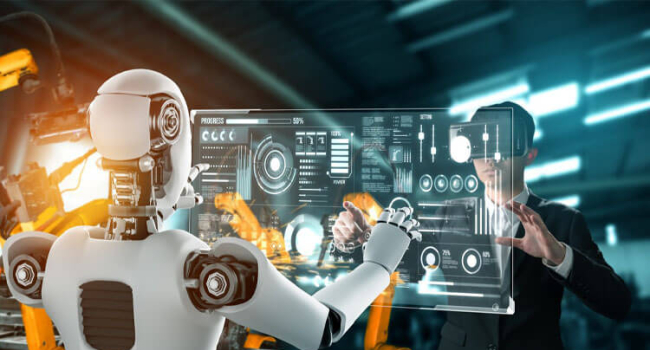
Robots learn without human involvement: A new breakthrough in robotics
Scientists from the University of Surrey and the University of Hamburg have developed a revolutionary method that enables social robots to learn and be tested without human participation. This technology accelerates research into human-robot interaction and opens prospects for applications in education, healthcare, and customer service.
How Does the New Technology Work?
Social robots interact with humans through speech, gestures, and facial expressions, but their training has traditionally required human volunteers. The new method eliminates this need through a gaze prediction model known as the scanpath model. This model allows robots to “guess” where a human would look in a given situation, mimicking human eye movements.
Researchers used two sets of open-source data to train robots to replicate natural responses. The model compares the robot’s behavior to how humans allocate attention in similar scenarios, assessing how accurately the machine “looks” at key objects.
Advantages of the Method
“Our approach verifies whether a robot focuses on the right elements as a human would, all without real-time human involvement,” said Dr. Di Fu, co-author of the study and a lecturer in cognitive neuroscience. He emphasized that the system remains reliable even in noisy and unpredictable environments, making it suitable for real-world scenarios.
This approach reduces the cost and time of experiments that previously required volunteers. Robots can now be tested and trained in virtual environments, simplifying development.
The Future of Social Robots
According to Dr. Fu, the new technology aims to create robots with heightened social sensitivity. Such machines will better navigate complex communication situations by anticipating human behavior. This is particularly crucial for sensitive fields like elderly care or child education.
Scientists believe their method is a step toward creating smarter, more empathetic robots capable of not just mimicking human actions but predicting intentions. This could lead to machines that intuitively understand how to interact with humans across diverse contexts.
Conclusion
The development of a method for autonomous learning in social robots marks significant progress in robotics. This technology, enabling machines to learn without human involvement, not only accelerates research but also brings us closer to creating robots that seamlessly integrate into daily life. In the future, such machines could become indispensable assistants, understanding humans at a level previously unattainable by technology.
- Related News
- Beijing opens "Kindergarten" for robots: Machines learn from their own mistakes
- Anthropic teaches AI to control real-world machines
- DeepSeek or ChatGPT: Which is better in 2026?
- 50,000 subscriptions and AI for schools: How Armenia plans to use artificial intelligence in education
- How to work with neural networks properly: 5 rules that actually help
- Why Bill Gates is no longer an AI optimist: Three major threats of AI
- Tech Jobs
- Most read
month
week
day
- Top tablets of August 2026: Experts name the best five 1727
- Top flagships of August 2026: Experts name the five best smartphones 1592
- 50,000 subscriptions and AI for schools: How Armenia plans to use artificial intelligence in education 875
- Two comets will be visible in Autumn 2026 733
- Samsung unveils monitor with record-breaking 1100 Hz refresh rate 733
- WhatsApp to introduce full passwords instead of PIN codes 659
- Foldable iPhone appeals to almost no one: Three-quarters of Americans don't want one 621
- A simple way to spend less time on your phone: Choosing your own goals? 608
- Would a nuclear explosion stop a city-killer asteroid? 601
- How to work with neural networks properly: 5 rules that actually help 589
- Archive