MIT study: building blocks of life could survive in the acid clouds of Venus
 12:33 3 September, 2026
Peptides are capable of not only surviving, but also folding into biologically useful shapes in the clouds of sulfuric acid enveloping Venus, according to a conclusion reached by researchers from MIT. The discovery challenges established ideas about where in the universe life could originate.
The study, published in the journal Proceedings of the National Academy of Sciences, showed that short chains of amino acids remained stable for several weeks in solutions of nearly pure sulfuric acid and adopted three-dimensional structures known as omega loops — formations that are sometimes found in natural proteins on Earth.
Building blocks that endured the test
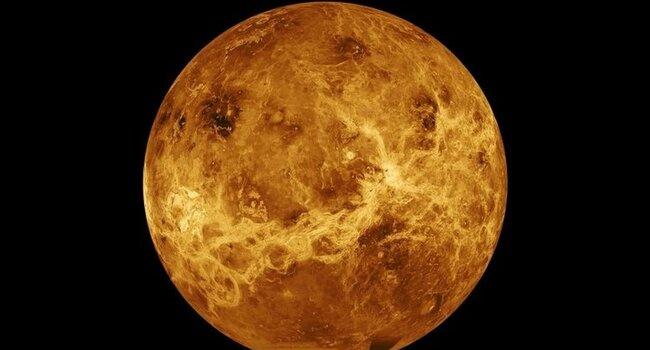
The cloud layer of Venus, extending at an altitude of 50 to 65 kilometers above the planet's scorching surface, features mild enough temperatures to theoretically allow for the existence of life. However, the clouds consist of about 98% sulfuric acid — a substance capable of dissolving metals and lethal to all known terrestrial organisms.
The study builds on a series of works by MIT started in 2020 that consistently tested whether biological molecules could withstand such conditions. Previous experiments showed that nucleic acid bases, lipids, and amino acids retain their structure in concentrated sulfuric acid. The new paper extends these results to peptides — more complex structures that play a key role in biological processes.
Contrary to intuition, the stability of peptides can be explained by the almost complete absence of water at a 98 percent acid concentration. Hydrolysis — the reaction that usually breaks peptide bonds in an acidic environment — requires water molecules, which are extremely scarce in such concentrated solutions.
"Without water, an acid that you would consider an aggressive solvent suddenly turns out not to be as frightening as one might think," noted study co-author Mei Hong.
Unexpected structures
Using an 800-megahertz nuclear magnetic resonance spectrometer, the team discovered that sulfuric acid molecules act as scaffolding: they penetrate the center of the peptide loops and hold them in omega-loop conformations that normally do not form in water. Such structures are believed to participate in protein folding and molecular recognition in terrestrial biology.
Ad Bax, head of the biophysical NMR section at the National Institutes of Health, called the findings "important and unexpected," noting that they open up the prospect of folded protein structures existing in environments radically different from those on Earth.
Expanding the search
These discoveries come at a time when private missions to Venus are gaining momentum. Seager, who leads the Morning Star missions to Venus, noted that this work should encourage a broader view of habitability when searching for exoplanets.
Further research will explore whether double-stranded peptide nucleic acid — a synthetic analogue of DNA — can replicate the structure of DNA under similar conditions. "We are looking for exoplanets that could be a true twin of Earth, but what if they all turn out to be Venuses?" said study co-author Sara Seager. "Our discoveries definitely open up a whole range of new possibilities."