Anthropic teaches AI to control real-world machines
 12:52 1 September, 2026
Until now, artificial intelligence has mostly operated in digital environments: writing code, analyzing documents, searching for information, and controlling software. But getting AI to interact with the physical world — for example, with a laboratory robot, microscope, or industrial machine — has required separate engineering work for each device.
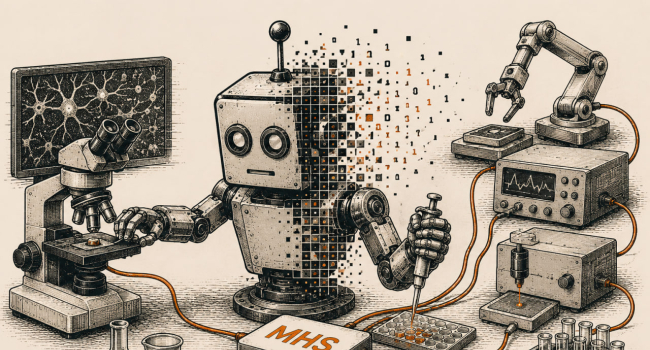
Anthropic wants to change that. The company has introduced a research version of the Model Hardware Standard (MHS), a standard designed to create a common interface between AI agents and physical devices. The idea is to eliminate the need for a separate method of controlling every machine. If equipment supports MHS, an AI agent will be able to receive data from it, send commands, and coordinate multiple devices through a shared interface.
In the future, this could lead to laboratories and manufacturing systems where AI does not simply analyze experimental results but can also independently control parts of the physical process.
Why laboratory equipment has been a problem for AI
As The Daily Star reports, modern scientific laboratories use a huge range of specialized equipment. A microscope from one manufacturer may run on its own software, a robotic arm on another system, and a liquid-handling device on a third.
For humans, this means creating software “bridges” between different devices. Integrating equipment can sometimes take weeks or even months.
MHS is designed to simplify this process. Instead of building a unique control system every time, a standardized driver is installed between the computer and the device.
The driver translates universal commands into instructions that a particular machine can understand.
The system also needs to know not only what a device can do, but also what limitations it has. For a robotic arm, for example, it is important to account for its maximum payload and other parameters that affect safe operation.
The capabilities and limitations of the equipment can be described in a format that an AI agent can understand. In effect, the model receives something similar to an operating manual for the connected device.
AI will be able to control multiple devices at once
Once the equipment is connected, an agent gets several ways to interact with it, including through the Model Context Protocol (MCP), the command line, programmatic code, and APIs.
The key point is not any individual protocol, but the ability to combine different machines into a single system.
For example, a laboratory could have a robotic arm, a liquid-handling device, a camera, and a sample reader operating at the same time. An AI agent could issue commands to them in sequence, receive the results, and use that information to determine its next action.
This is fundamentally different from a conventional model that simply answers questions or writes software.
AI begins to operate in a closed loop: command → action → result → analysis → new command.
In other words, the system could potentially do more than simply carry out a predefined experiment. It could analyze what is happening and modify the experiment while it is underway.
Early tests have already taken place in real laboratories
MHS is still at the research testing stage, but Anthropic has already tested the system with several scientific organizations and companies.
At Genentech, for example, MHS was used to connect a liquid-handling device, a robotic arm, and a microplate reader. An AI agent controlled the experiment, analyzed the results, and adjusted the equipment parameters.
But the experiment also exposed one of the technology’s weaknesses. When bubbles appeared in the system, Claude tried to repeat the operation using different parameters. Instead, this made the problem worse: additional mixing produced even more bubbles.
Researchers had to explain to the model that the problem was caused by a physical issue rather than an incorrect experimental parameter. Cases like this highlight just how difficult it is to teach AI to understand the physical world.
MHS is not limited to Claude
Another important detail is that the standard is being designed to be model-agnostic, meaning it is not intended exclusively for Anthropic’s own models.
In the future, any compatible AI agent could potentially interact with physical equipment through standardized protocols.
Anthropic is already working with companies in robotics and hardware. For example, Hugging Face is integrating MHS support into its LeRobot library, while Raspberry Pi is also working on support for the standard in some of its products.
If the technology becomes an open standard, its significance could extend far beyond Anthropic’s ecosystem.
The next step is an open standard for physical AI
For now, MHS is available to a limited group of research laboratories and hardware manufacturers. Anthropic plans to use this stage to develop safety practices and evaluate how the system performs before making the standard protocol available for broader use.
If MHS gains widespread adoption, it could become an important step in the transition from AI that works with information to AI that works with the physical world.
Today, this still requires engineers, specialized drivers, and numerous integrations. In the future, it may be enough to connect equipment to compatible infrastructure, allowing an AI agent not only to access data from a device but also to use the device itself as a tool for solving a task.
Essentially, the goal is to create a common language between artificial intelligence and machines.
And if that language becomes truly universal, laboratory equipment, industrial robots, and other programmable devices could become a kind of toolkit for AI — much like browsers, terminals, and computer code are tools for AI today.