Kawasaki and Nvidia to create “physical AI” development center in the U.S.
 13:04 25 May, 2026
Kawasaki Heavy Industries has announced a major partnership with Nvidia, Microsoft, and Fujitsu to develop next-generation robotics.
The companies will establish a joint research center in San Jose, Silicon Valley, focused on creating “physical AI” — systems capable of operating effectively in the real world.
Focus on practical applications
At the initial stage, the partners will focus on three key areas:
- medical robots;
- assistance systems for elderly people;
- future personal transportation.
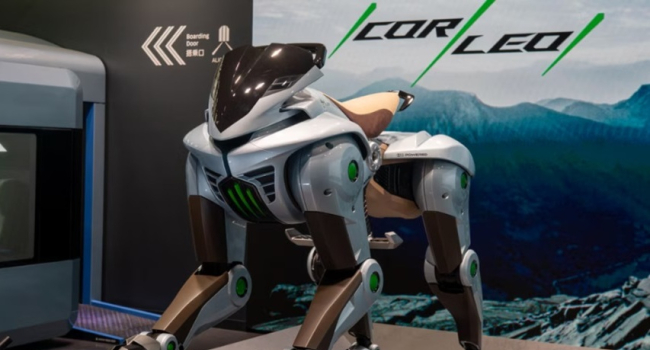
Particular attention will be given to the Corleo project — an experimental four-legged robot developed by Kawasaki Heavy Industries that is designed to move across difficult terrain.
What Corleo is
The robot is roughly the size of a large motorcycle. It is equipped with a 150 cc hydrogen engine that powers strong actuators in its legs.
Interestingly, Corleo is not controlled through a traditional steering mechanism. Instead, it responds to shifts in the rider’s center of gravity, similar to a Segway or hoverboard.
Kawasaki plans to showcase the robot at Expo 2030 Riyadh and hopes to begin commercial sales by the middle of the next decade.
Nvidia’s role and virtual training
Collaboration with Nvidia is expected to significantly accelerate development of the project. The company will provide advanced simulation tools and AI platforms that allow robots to be trained in virtual environments before deployment in the real world.
This approach substantially reduces both the risks and costs associated with physical testing.
Market reaction
Investors responded positively to the announcement. Shares of Kawasaki Heavy Industries rose nearly 12% in a single day, marking the company’s strongest daily gain since February.
The news also boosted shares of other Japanese industrial robotics manufacturers.
Analysts view the partnership as an important signal that the industry is moving into a new phase — from traditional industrial automation toward genuinely intelligent autonomous machines capable of operating alongside humans.
In brief
Kawasaki Heavy Industries, together with Nvidia, Microsoft, and Fujitsu, is opening a “physical AI” development center in San Jose. The flagship project will be Corleo, a four-legged hydrogen-powered robot controlled through body movement. The partnership aims to accelerate the development of medical robots, elderly-care assistants, and future personal transportation systems. Kawasaki shares rose nearly 12% following the announcement, while commercial launch of Corleo is expected by the mid-2030s.