China’s Humanoid Robot Sector: Real-World Implementation Outpaces the U.S.
 15:14 5 May, 2026
Asia's humanoid robotics sector is steadily pulling ahead of Western competitors in the transition from exhibition booths to factory floors, power grids, and airport aprons. According to analysts, this gap is driven by China's national industrial policy and a relentless focus on cost-effective technological implementation.
From Demonstrations to Production Lines
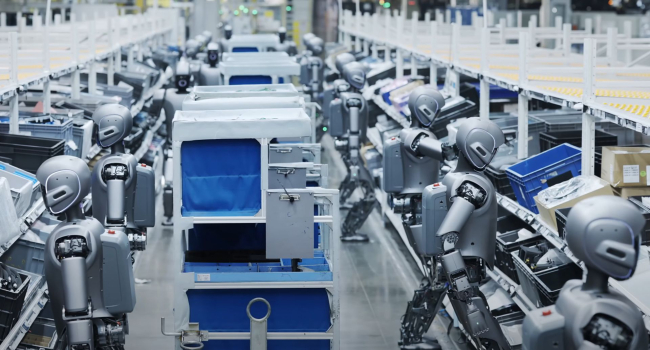
CATL, the world’s largest EV battery manufacturer, launched in December 2025 what it called the "world’s first" large-scale deployment of humanoid robots at its Zhongzhou manufacturing facility in Luoyang, Henan Province. Developed by the startup Spirit AI and named "Xiaomo," these robots connect high-voltage battery connectors on the assembly line—a task long considered hazardous for humans. Operating on a "vision-language-action" AI model, the machines achieve a 99% success rate and triple the daily productivity of a human operator, as they require no breaks.
The stakes were raised even further by the State Grid Corporation of China. According to the South China Morning Post, the company allocated 6.8 billion yuan (approximately $1 billion) to procure around 8,500 AI-powered robots in 2026 for operations across 26 regions—including power line inspections, live-line maintenance, emergency rescue operations, and logistics. Combined with contributions from the China Southern Power Grid, this figure exceeds $1.46 billion.
Japan Joins the Trend
Japan Airlines announced on April 28 the launch of a pilot project using humanoid robots for baggage and cargo handling at Tokyo's Haneda Airport, starting in May in partnership with GMO AI & Robotics. The Unitree G1 models, manufactured in Hangzhou, stand 130 centimeters tall and are capable of maneuvering in cramped aircraft cabins without expensive infrastructure upgrades. The two-year pilot aims to address Japan's acute aviation personnel shortage caused by an aging population and record growth in inbound tourism.
Investor Interest and the Valuation Gap
On May 4, Reuters reported that Beijing-based Linkerbot—which claims over 80% of the global market share for high-degree-of-freedom robotic hands—is planning to raise funding at a $6 billion valuation. This is double the valuation from its recently completed round involving Ant Group and state funds. The company intends to ramp up production to 10,000 hands per month, up from the current nearly 5,000.
The contrast with American valuations is striking. In April, CNBC reported that the U.S. humanoid robotics firm Figure is valued at no less than $39 billion, despite significantly lower shipping volumes. In the 2025 global shipment rankings by research firm Omdia, Chinese startups claimed the top six spots. Andreas Brauchle of the consulting firm Horváth described the situation as follows: "China is currently ahead of the U.S. in the early commercialization phase of humanoid robots. While both countries are expected to develop comparably large markets over time, China is scaling faster at this initial stage."