Humanoid Robotics Has Reached an Inflection Point - JPMorgan
 15:28 29 April, 2026
The humanoid robotics industry has reached a "critical inflection point," transitioning from proof-of-concept to large-scale deployment, during which capital is concentrating among platform market leaders and high-quality component suppliers. This was noted in a research report by JPMorgan. xnews.com
The Race to the Factory Floor
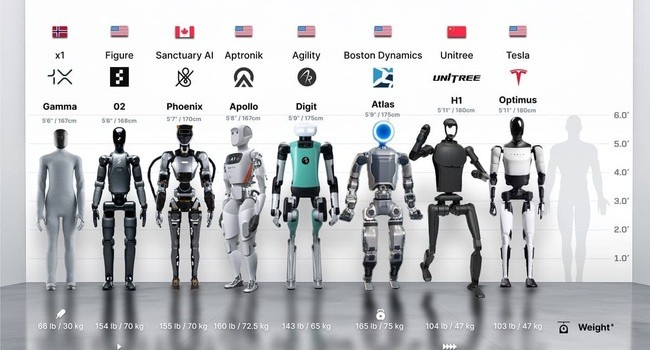
The JPMorgan report highlights a competitive landscape where Chinese manufacturers are moving the fastest. The bank noted that Tesla "seeks to catch up with nimbler Chinese competitors and Boston Dynamics." Chinese companies, including Unitree, BYD, and Agibot, are targeting a combined output of tens of thousands of units this year, and a new factory in Guangdong province operated by Leju Robotics began producing one humanoid robot every 30 minutes in late March.
Tesla CEO Elon Musk confirmed on an earnings call following the first quarter of 2026 on April 22 that production of Optimus robots at the company's Fremont, California, plant will begin in late July or August—following the cessation of Model S and Model X production at that facility in early May. Musk warned that the initial production volume would be "quite small," calling the output rate "literally unpredictable" given that Optimus consists of 10,000 unique parts. A second Optimus production facility at Giga Texas is expected to begin operations around the summer of 2027.
Meanwhile, Boston Dynamics presented the production version of the Atlas robot at CES 2026 in January, with all 2026 deliveries already reserved by Hyundai and Google DeepMind. Hyundai, the majority shareholder of Boston Dynamics, plans to deploy Atlas at its Metaplant America facility in Savannah, Georgia, by 2028, with a long-term goal of mass-producing 30,000 units per year.
Capital Concentrates at the Top
JPMorgan's analysis aligns with broader funding data indicating extreme capital concentration in the sector. According to an April study by New Market Pitch, the top 10 largest deals account for 95.4% of total raised capital, with a median round size of $111 million—unusually high for an emerging market. Companies developing general-purpose humanoid robots attracted 62.3% of the capital with only a 31.3% share of the total number of deals. North America and the Asia-Pacific region collectively account for 97.1% of disclosed funding, while Europe's share is only 2.9%.
JPMorgan is betting on companies such as Ubtech Robotics, Hyundai Motor, Sanhua, and Hengli Hydraulics, viewing them as beneficiaries of the next growth wave. Manufacturing costs in the industry are declining by approximately 40% per year—a pace significantly ahead of the previously projected 15–20%.