RAM prices have spiked sharply: What to expect for smartphone and laptop prices in 2026
 20:50 7 January, 2026
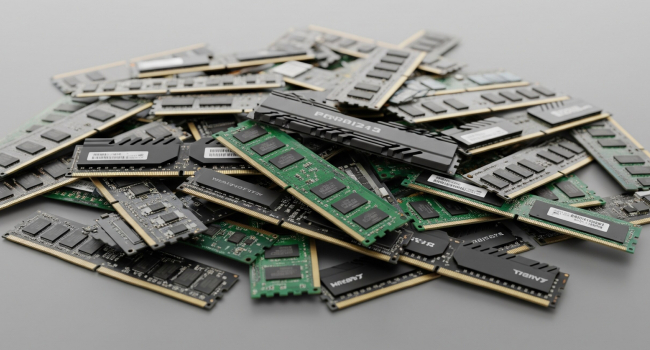
At the end of 2025, the global market for RAM DRAM and flash memory NAND is experiencing an acute crisis. Prices have surged severalfold due to explosive demand for components used in artificial intelligence. This directly affects the cost of smartphones, laptops, and PCs. In Russia, the situation is compounded by local factors, and experts predict a significant price increase in 2026.
Reasons for the Global Shortage
The crisis began in the autumn of 2025, when spot prices for DDR5 chips rose by more than 170 percent year over year. The main driver is the AI boom. Data centers operated by Google, Microsoft, OpenAI, Meta, and major Chinese companies require enormous volumes of high speed HBM High Bandwidth Memory for training models and powering NVIDIA accelerators.
Manufacturers Samsung, SK hynix, and Micron have redirected production capacity toward HBM and server grade DRAM, cutting output of consumer memory DDR4 and DDR5. Micron even announced its exit from the consumer market, shutting down the Crucial brand.
Additional factors include US trade restrictions against China, which triggered panic buying, and retail level anxiety, with consumers purchasing memory in advance.
Eldar Murtazin, lead analyst at Mobile Research Group, noted that there has been no reduction in production. Factories are running at full capacity, but expansion is impossible. Demand growth was expected to be about 10 percent in the number of modules and 30 percent in memory volume, but it has reached roughly 100 percent and 200 percent respectively. No one was prepared, and there is simply not enough manufacturing capacity.
Arsen Gaidarilov, a manager at M.Video, added that the AI segment consumes significantly more DRAM and NAND, creating shortages in the retail market.
Impact on Prices in Russia
In Russia, price increases are already clearly visible. A 32 GB DDR5 kit has risen from 12 to 15 thousand rubles to 45 to 50 thousand rubles, while 64 GB kits now reach around 100 thousand rubles. One terabyte SSDs have increased from 9.5 thousand to 15 thousand rubles.
The share of memory in device production costs has grown from 6 to 7 percent to around 20 percent. For laptops and PCs, the share is even higher, ranging from 15 to 40 percent.
Murtazin predicts that electronics prices in Russia will rise by 25 to 35 percent in 2026, taking into account the shortage, a technology levy planned for September 2026, and mandatory product labeling.
Large brands such as Apple and Samsung are expected to cope better thanks to fixed supply contracts, while smaller manufacturers may face shortages.
There may also be a return of microSD card slots in Android smartphones to compensate for reduced internal storage capacities.
Laptops are likely to be hit harder. By December 2025, prices had already increased by about 10 percent, and graphics cards and SSDs are also becoming more expensive.
The server segment is under severe pressure as well, with ECC memory prices rising by 40 to 80 percent.
Outlook for 2026
Analysts expect the shortage to continue until 2027 or 2028, until new production capacity comes online. Device prices are likely to rise in stages with each new shipment.
Experts recommend buying devices with larger amounts of memory now, while older stock is still available at pre crisis prices.
In Brief
The memory crisis of 2025 to 2026 is driven by the reorientation of production toward AI, leading to shortages of DRAM and NAND for consumers. Component prices have increased severalfold, pushing device production costs up by 10 to 20 percent. In Russia, a 25 to 35 percent price increase is expected in 2026 due to the global shortage, additional levies, and labeling requirements. Smartphones and laptops will become more expensive and configurations will be simplified, while large brands are likely to remain more resilient. The recommendation is to upgrade now, before prices reach their peak.