China unveils the cheapest humanoid robot yet: It costs about the same as an iPhone
 14:31 16 December, 2025
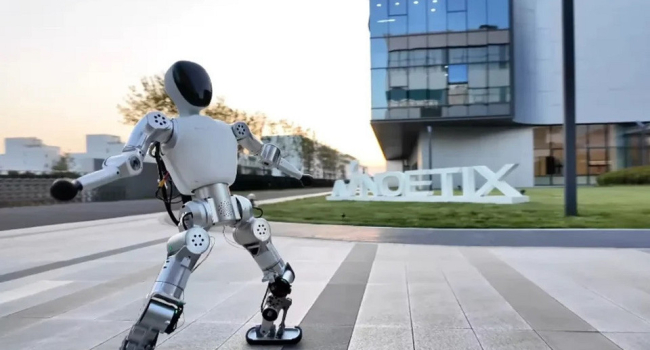
Chinese company Songyan Power has announced Bumi, a humanoid robot positioned as an affordable assistant for home and educational use. Priced at 9,998 yuan (around $1,400), it has become the cheapest humanoid robot on the market. Sales are set to begin in January 2026, a move that could mark a real turning point in the mass adoption of humanoid robots.
What Bumi Can Do — and Why It Is So Cheap
Bumi is a full-size humanoid robot, standing approximately 1.5–1.7 meters tall (exact dimensions have not yet been disclosed). It can walk, run, dance, respond to voice commands, and perform simple tasks. Programming is available through an intuitive interface that does not require deep knowledge of robotics.
The manufacturer emphasizes educational and home use: the robot can help children with homework, provide entertainment, or carry out basic household activities.
Its key advantage is the price. For comparison, Tesla’s Optimus is estimated to cost $20,000–30,000 to manufacture, while the industrial Digit robot from Agility Robotics sells for around $250,000. The Chinese model focuses on large-scale production with minimal margins, allowing the price to drop dramatically even if profitability per unit is low.
China vs. the West: Speed Versus Quality
In the United States and Europe, the focus is on safety, autonomy, and industrial applications. Robots like Optimus or Figure 01 are designed primarily for factories and warehouses, where reliability and AI integration are critical. This approach slows down scaling but creates more sustainable long-term business models.
China, by contrast, is pursuing an aggressive strategy: rapidly bringing low-cost devices to market, capturing volume, and undercutting competitors on price. Bumi is a clear example. It does not aim to lead in performance, but for $1,400 it offers a basic humanoid robot that can be purchased much like a high-end smartphone.
Risks and Prospects
Low-cost humanoid robots could accelerate adoption in education, entertainment, and everyday life. Children could learn programming on a real robot, while elderly users might gain a simple companion. However, the low price comes with risks: simplified materials and software may lead to faster obsolescence and potential safety concerns. In the long run, this could also slow innovation in the premium segment.
In Brief
China’s Songyan Power has introduced the humanoid robot Bumi for about $1,400, making it the most affordable option on the market. With capabilities such as walking, dancing, and voice control, it is aimed at home and educational use, with sales starting in January 2026. The launch reflects China’s broader strategy of prioritizing speed and scale, in contrast to the West’s focus on quality and industrial applications. Humanoid robots are moving into the mass market — soon, they may be as easy to buy as consumer electronics.