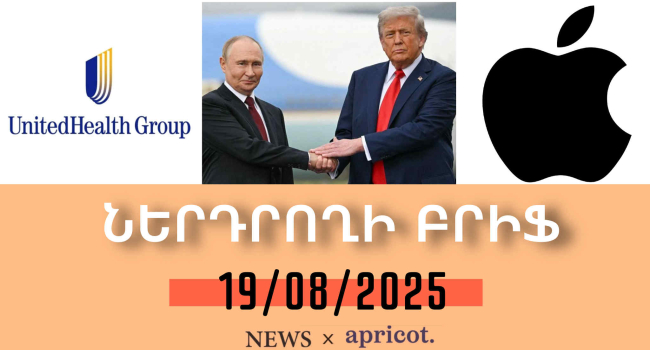
Investor Brief 19.08.2025: How did Trump-Putin meeting affect stock market?
 11:00 19 August, 2025
Among companies with a capitalization of at least $10 billion, Paramount Skydance Corporation recorded the largest increase last week. The shares of this media and entertainment conglomerate rose by 30.54% in a week—to $13.72 per share. Next is Intel Corporation, the world's leading manufacturer of microprocessors and semiconductors, with a 23.11% increase—to $24.56 per share. This happened after it became known that the US government may invest in this struggling chipmaker. And this top three was rounded out by Bloom Energy Corporation, a developer of clean energy solutions, with a 23.04% increase—to $45.28 per share.
The top three largest-cap companies with the biggest losses last week start off with CoreWeave, Inc., a cloud computing infrastructure company, whose shares fell 22.83% to $99.97 per share. Next was Coherent Corp., a manufacturer of laser optical technologies and electronic components, down 19.09% to $93.40 per share. And this top three was rounded out by Ubiquiti Inc., a provider of networking equipment and technology solutions, down 14.15% to $402.80 per share.
The US stock market has recorded a second consecutive week of growth. The Dow Jones Industrial Average rose 1.74%, the S&P 500 rose 0.94%, and the Nasdaq rose 0.81%. The Russell 2000 index, which tracks small companies, recorded the largest increase, up 3.13%.
European stocks also posted a second consecutive weekly gain last week, driven by hopes of a possible refinancing interest rate cut in the US soon and solid financial results. The STOXX 600 index fell 0.1% on August 15, but held near a five-month high.
Global markets were cautious last week as investors awaited the outcome of the meeting between US President Donald Trump and Russian President Vladimir Putin in Alaska. Brent crude oil fell 1.5% to $66.85 a barrel. The reason was that if tensions in Ukraine eased as a result of the two presidents' meeting, it would lead to a decrease in oil demand. The US dollar fell amid expectations of a US refinancing interest rate cut in September. The dollar index fell by 0.34%, gold rose slightly by 0.09%, US Treasury bond yields rose slightly, and the 10-year bond yield reached 4.32%.
Global stock funds saw their biggest weekly inflows in six weeks last week, pulling in $19.3 billion amid relatively low inflation expectations and a tariff deal reached with China. Technology stocks led the gains; funds covering Apple were particularly popular. Bond funds remained in demand for the 17th consecutive week, attracting $15.87 billion.
UnitedHealth Group shares rose about 14% after Warren Buffett's Berkshire Hathaway bought 5 million shares of this healthcare sector giant, signaling that the seasoned investor has confidence in this company's long-term prospects. The company, which has lost about 40% this year, has posted its biggest one-day gain since 2008.
The shares of Miami International Holdings, a US financial stock exchange operator, surged 38% on August 13, exceeding its share issue price, valuing the operator at about $2.5 billion. MIAX became the first major US financial stock exchange to go public in the past 15 years.
On August 12, a total of 25 billion drams of government bonds were placed on Armenia’s stock market, and they will be redeemed on April 29, 2030. The public auction had four participants, and the bids submitted by them amounted to 72.105 billion drams. The weighted average price of the placed government bonds amounted to 95.9685 drams, and the yield was 9.6793 percent.
On Monday, a total of 5 billion drams of government bonds were placed on Armenia’s stock market, and they will be redeemed on June 1, 2026. The public auction had four participants, and the bids submitted by them amounted to 8.031 billion drams billion drams. The weighted average price of the placed government bonds amounted to 94.0189 drams, and the yield was 8.0076 percent.
US production prices rose 0.9% in July, the biggest gain in three years, driven primarily by higher prices for goods and services. This suggests that the pressure of new tariffs is already being passed on to consumers, complicating the US Federal Reserve’s plans to cut refinancing interest rates. Core inflation, as measured by the PCE index, rose to a 2.9% annual rate in July.
The US federal budget deficit rose 19% in July to $291 billion, even as revenue from new tariffs nearly tripled to $21 billion. Government spending, especially on social security, health care and debt repayment, has grown faster than revenues, leading to a larger deficit.
Are you interested in investing? Discover your opportunities with Apricot Capital!
Apricot Capital is regulated by the Central Bank of RA.