Four-legged robot Olympus: How it could help explore Mars
 18:51 11 August, 2025
The European Space Agency (ESA) has released a video showcasing the capabilities of Olympus, a four-legged robot designed for exploring Mars and the Moon. In tests conducted at the Orbital Robotics Interactive Test (ORBIT) facility in the Netherlands, the robot successfully leapt from wall to wall under simulated Martian gravity, demonstrating how it could traverse rugged terrain inaccessible to traditional wheeled rovers. Here’s how Olympus works, the advantages it offers, and why it could reshape the future of space missions.
What Is Olympus?
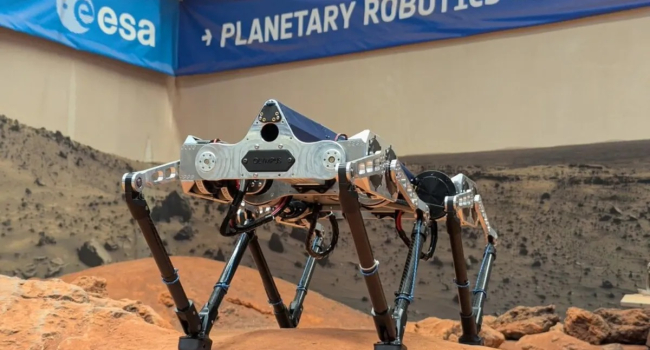
Olympus is a quadruped robot built for operation in low-gravity environments such as Mars (38% of Earth’s gravity) and the Moon (16% of Earth’s gravity). Its unique design features:
- "Double" limbs: Each of its four legs consists of two segments with knee joints and paw-like pads, providing high maneuverability.
- Adaptability: The robot can stabilize itself, jump, and reorient in microgravity.
- AI-powered agility: Olympus uses reinforcement learning — a machine learning technique that allows it to adapt to new conditions through trial and error.
The robot’s developer, Jørgen Anker Olsen, a PhD candidate at the Norwegian University of Science and Technology, emphasizes that Olympus could be key to exploring hard-to-reach locations such as Martian lava tubes or caves, which are too dangerous for drones or flying probes.
Testing at ORBIT
The trials took place at ESA’s ORBIT facility, which simulates microgravity under controlled conditions:
- Air-cushion platform: Olympus was mounted upside down on a platform that glided over an ultra-flat floor on a thin layer of air, much like an air hockey puck. This setup reproduced a state of weightlessness in two dimensions.
- Motion trials: The robot demonstrated a full range of leg movements, including swimming-like motions for spatial orientation.
- Leaping tests: In simulated Martian gravity, Olympus jumped from wall to wall, consistently landing on all four legs.
ESA’s video shows Olympus using reinforcement learning to autonomously control its orientation. This allowed it to quickly adapt to platform rotation and execute complex maneuvers without human intervention.
Advantages Over Traditional Rovers
Wheeled rovers such as Perseverance or Curiosity are limited when traversing uneven surfaces. Olympus addresses this problem:
- Mobility: In low gravity, it can leap over obstacles like boulders or fissures that stop wheeled vehicles.
- Cave access: Lava tubes and subsurface voids on Mars — potential sites for water or life — are too risky for drones due to limited battery life and navigation challenges. Olympus could safely explore such environments.
- Stability: Its four-legged design and AI-driven control keep it steady even on unstable surfaces.
Olsen notes that such robots can “jump over barriers that are insurmountable for current rovers,” opening access to previously unreachable regions.
Significance for Future Missions
The Olympus technology highlights the potential of quadruped robots for planetary exploration in low-gravity environments. Unlike flying probes such as NASA’s Ingenuity Mars helicopter, which are constrained by battery life and vulnerable to harsh conditions, Olympus offers both mobility and durability. Its ability to learn autonomously makes it ideal for missions where communication with Earth is delayed or limited.
ESA plans to continue ORBIT-based trials to refine its algorithms and test Olympus in more complex scenarios. In the future, such robots could join missions to Mars, the Moon, or even asteroids, complementing wheeled rovers and drones.
Bottom Line
The four-legged Olympus robot, which has successfully passed tests under simulated Martian gravity, opens new possibilities for space exploration. Its ability to jump, stabilize, and adapt to challenging terrain makes it a unique tool for reaching caves and rugged surfaces on Mars and the Moon. While still in the demonstration stage, its achievements at ORBIT confirm the potential of quadruped robots for future missions. ESA’s ongoing work on Olympus could help astronauts and robotic explorers push deeper into the Red Planet.