Investor Brief 12.12.24. Alphabet's stocks skyrocket thanks to quantum chip
 10:06 12 December, 2024
US labor costs rose much less than expected in the third quarter, and this is a good indicator for inflation forecasts. The Department of Labor said labor costs rose at an annual rate of 0.8%, while earlier analysts predicted a 1.9% growth. This slow increase in labor costs is likely to be welcomed by Federal Reserve officials, who are expected to cut the refinancing rate by another 25 basis points next week. Analysts say wage growth is slowing, which could ease inflationary pressures.
In November, US small business confidence reached its highest point in the last almost 3.5 years, which, according to analysts, was helped by the optimism following the elections. After Donald Trump's victory, the small business optimism index rose by 8 points to 101.7. Small business owners, who mostly support Republicans, expect an improved economy and higher sales, and believe now is a good time to expand their businesses. More businesses plan to create new jobs and raise wages. About 32% of owners have already raised wages, and 28% plan to do so in the next three months.
US Federal Reserve officials are likely to cut refinancing interest rates this month, but there is growing caution over the pace of further cuts. Statistics show that the US labor market remains strong but is slowing. Employers have opened 227,000 new jobs in November, but the unemployment rate rose slightly to 4.2%. The average monthly job increase over the past six months is less than 150.00, which according to some analysts, is not in line with the population growth rate. Some Federal Reserve officials, including chair Jerome Powell, believe the refinancing rate should continue to be cut, but they say the process should be slowed because inflation is still high and the labor market is healthy. If the Federal Reserve this month decides to cut the refinancing rate again, it will reach a range of 4.25%-4.50%, which is one percentage point lower than this compared to in September.
US services sector activity slowed in November after strong growth. But analysts said it was still growing at a healthy pace, enough to ensure expectations of steady economic growth in the fourth quarter. The Institute for Supply Management said the services index fell slightly to 52.1 in November from 56.0 in October. Businesses, however, are still optimistic that demand for services will pick up in the coming months. Despite the slowdown in services, consumer spending remained strong, and car sales rose in November. According to the Federal Reserve system of Atlanta, the annual growth rate of the economy will be 3.2% in the fourth quarter. Overall, the US economy is doing well, but businesses are cautious as the pace of inflation remains a concern, especially in services such as public transportation and insurance.
Orders from US plants have increased slightly by 0.2% in October. However, orders for non-defense capital goods fell 0.2% in October. This suggests that businesses may be cutting back on spending on new equipment. Shipments of these products increased by 0.3%, but growth is still weak compared to before. Overall, although plant orders rose, business investment in equipment appears to have slowed in the fourth quarter after strong growth in the previous two quarters.
Global stock markets fell Tuesday, while the US dollar rose as investors await new economic data, including US inflation indicators and a European Central Bank meeting later in the week. Gold prices hit a two-week high in connection with rising geopolitical tensions and with expectations that the US Federal Reserve system will cut refinancing rates again next week. All US stock indexes have fallen. The Dow Jones was down 0.35%, the S&P 500 was down 0.30%, and Nasdaq was down 0.25%. The European STOXX 600 index was also down 0.5%. Investors are awaiting the US Consumer Price Index report, which will show inflation trends, which will affect the Federal Reserve's decisions. Most economists expect the Federal Reserve to cut interest rates by 0.25% at its December meeting.
Shares of Google’s parent company, Alphabet, on Tuesday rose nearly 5% after the company unveiled its new quantum computing chip, called Willow. Google has announced that this chip has solved the basic quantum computing problem in just five minutes—a problem that would take a conventional computer millions of years. Quantum computing is designed to run much faster than traditional computers, but it faces challenges because the smallest units of information, called qubits, are error-prone. The more qubits are used, the more errors occur. Google's Willow chip solves that problem by connecting the qubits so that the more they increase, the fewer errors it makes, and it can even correct errors in real time. Although quantum computing is not yet widely used, Willow could lead to major advances in science, medicine, and finance. Tuesday was the best day for the Alphabet stocks since April, and their price has increased by 25% during this year.
Oracle's stock price on Tuesday fell more than 9% after the company reported lower-than-expected earnings for the quarter. If the losses persist, Oracle could lose about $50 billion in market value. While Oracle's shares have risen 80% this year thanks to the company's investments in cloud infrastructure to meet AI demand for cloud computing, Oracle's revenue in the second quarter was $14 .06 billion, up 9% from last year, but below analysts' estimates of $14.11 billion. Despite the stock drop, 21 brokerages have raised their price targets on Oracle, and analysts believe the company's partnerships with other cloud providers, such as Azure and Google Cloud, could help improve earnings.
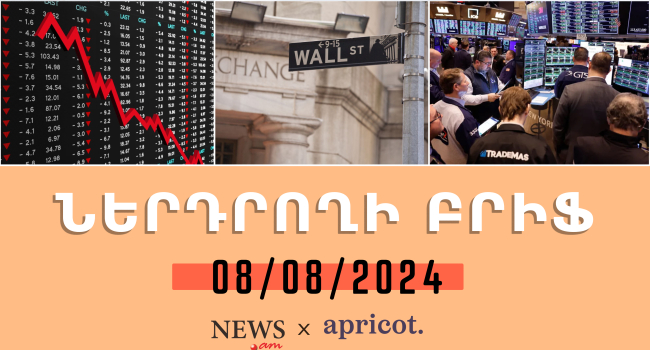
Investor's brief 08.08.24։ The sharp fall and rise of stock markets
NEWS.am together with Apricot Capital is launching a new project "Investor's Brief" in order to contribute to the formation of investment culture in Armenia. From now on, every Thursday on our website and YouTube channel, you can get the latest news of the global financial markets in order to be aware of the transition of the sector and get to know the investment world better.
Against the backdrop of concerns about the decline of the US economy, a sharp decline was recorded in the world financial markets this week. On Monday, June 5, the biggest drop in the last two years took place in the US stock market. On the same day, the S&P 500 fell 3%, the Dow Jones industrial average fell more than 1,000 points and the Nasdaq Composite fell 3.4%.
The massive sell-off in stocks around the world began with Japan's Nikkei 225 falling 12.4%, the biggest since Black Monday in 1987. South Korea's Kospi index fell by 8.8%, and stock markets across Europe fell by more than 2%.
Nevertheless, the very next morning, the Japanese stock market began to rise again, recouping most of the previous day's losses, and stability was established on Wall Street.
On Tuesday, August 6, London's FTSE 100, which had fallen 2% yesterday, rose 18 points or 0.2%. On Wall Street, Dow Jones closed up 0.8%, S&P 500 - up 1.5%. Nasdaq registered a 1% increase. The Japanese Nikkei 225 closed up 10.2% compared to the previous day. Other Asian stock markets also rose.
The jitters in global stock markets came after a US jobs report showed the US unemployment rate hit a three-year high of 4.3% in July, down from 4.1% the previous month, amid a sharp slowdown in hiring. This has fueled fears that the labor market is deteriorating, signaling an impending economic downturn. Just a few days before this report, the stock indices in the US reached their best figures in recent months, after the chairman of the Federal Reserve System, Jerome Powell, expressed hope that a reduction in the refinancing rate is possible from September.
But after the unemployment report, fears grew that the Federal Reserve may have been too late to cut the refinancing rate, raising the risk of a crisis in the world's largest economy.
Traders are now wondering if the damage has been so severe that the Federal Reserve will be forced to cut refinancing rates in an emergency meeting instead of waiting for a regular meeting scheduled for September 18.
Against the backdrop of expectations of a decline in the US economy, the yield curve of US treasury bonds has turned positive for the first time in the last two years. This means that short-term bonds had a lower yield than long-term bonds. This situation usually suggests that the country's economy is on the verge of recession.
Are you interested in investing? Discover their opportunities with Apricot Capital.
Apricot Capital is controlled by the Central Bank of RA.