Robot dentist working with AI treats human teeth for first time (video)
 13:34 1 August, 2024
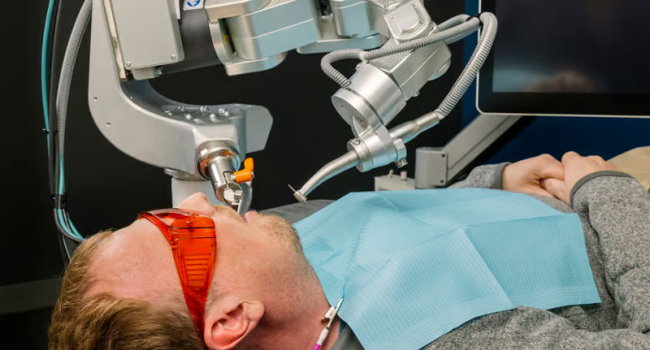
The Boston-based company Perceptive has introduced the world’s first robotic dentist, which, powered by artificial intelligence, can perform a procedure on a live person’s teeth autonomously. Dental offices are rarely associated with warm feelings, and few people would want to spend an extra hour there. The robot developed by Perceptive addresses this issue—it completes the tooth preparation for crown placement in just 15 minutes, compared to the usual two-hour sessions, New Atlas reports.
Currently, this solution is not approved for clinical use, so robotic dentists are not expected to be in widespread practice anytime soon. However, this is likely to change eventually. Telemedicine is becoming a standard practice, paving the way for tools for remote surgeries and AI-powered training platforms.
The Perceptive robotic dentist currently performs only one procedure—preparing teeth for crown placement. Typically, a human dentist schedules two sessions of two hours each for this procedure. The robot, however, completes the task in 15 minutes. Moreover, it safely handles teeth preparation even if the patient is moving.
“We are excited to complete the world’s first fully automated robotic dental procedure,” said Dr. Chris Ciriello, CEO and founder of Perceptive. “This medical breakthrough enhances the accuracy and efficiency of dental procedures and also democratizes access to higher-quality dental care, resulting in better clinical outcomes for patients. We look forward to advancing our system and creating innovative, scalable, fully automated dental solutions for patients.”
Before starting the procedure, the dentist scans the patient’s oral cavity with a handheld OCT scanner. Based on the images, which detect cavities with 90% accuracy, the AI is tasked with the procedure (which is also discussed with the patient). The robot then begins work, preparing the teeth with the precision of a CNC machine. According to the company, this process is quick, painless, precise, and potentially more cost-effective than work performed by a human dentist.